Construction and Engineering A/R: How to Get Paid Faster
From foundation to finishing, get paid faster with automated follow-ups.

Table of contents
Share
Construction, engineering and field services firms get paid slowly for structural reasons, not because their customers refuse to pay. Retainage holds back part of every progress payment, pay applications need sign-off before they count, and change orders sit unpriced while the work goes ahead. The fix is follow-up that starts before the due date, tracks each pay app and retainage balance on its own, and reaches the person who actually approves payment.
Construction typically runs 60 to 90 days of DSO, against 45 to 60 in manufacturing, according to Credit Pulse's DSO by industry benchmarks. Across all US B2B credit sales, 43% of invoice value was overdue in 2025 (Atradius, 2025). For a contractor carrying payroll, materials and equipment between draws, that gap is the difference between bidding the next job and borrowing to finish the current one.
This page covers how firms in civil, commercial and specialty construction, engineering, and field services (fire protection, HVAC, mechanical, electrical, facilities) actually bill, why their receivables run long, and how follow-up should work for their buyers.
How Do Construction and Engineering Firms Actually Bill?
Most firms in this group bill in four ways, often several of them on the same project. Each one has its own reason for stalling, so each needs its own follow-up.
Progress billing and pay applications
On commercial work, the invoice is usually a pay application: a schedule of values, the percent complete on each line, and the amount due this period. The general contractor or the owner's representative reviews it, sometimes marks lines down, and only then does payment move. A pay app that misses the monthly submission cutoff waits a full cycle, which can add 30 days before anyone has done anything wrong.
Retainage
Retainage holds back a fixed percentage of each progress payment, set in the contract, until substantial completion or closeout. It is revenue you have already earned that sits on the books for months, and it is the balance most likely to be forgotten once the crew moves to the next job. Our guide to construction DSO and retainage shows how to track it as its own line so it does not hide inside the aging report.
Change orders
Work gets added in the field long before the paperwork catches up. An unsigned or unpriced change order is one of the most frequent reasons a construction invoice gets disputed, because the customer's approver has nothing to match it against. The practical fix is in our guide to change order billing: price it, get it signed, then bill it.
Service and maintenance invoices
Field service firms run a second receivable alongside project billing: a high volume of small inspection, repair and service-call invoices. Each one is easy to pay and easy to ignore. Added up across a few hundred customers, that small-invoice balance is often larger than any single project receivable, and it is the part of the ledger that nobody has time to chase. Our guide on how fire protection companies get paid faster on inspection and service invoices walks through a follow-up playbook for exactly this kind of ledger.
Why Do Construction Receivables Run So Long?
Most slow construction payments are not refusals. They are invoices waiting on a document, a signature or a person nobody has called. Three things stack up.
Payment chains
A subcontractor often waits for the general contractor, who waits for the owner or the lender's draw. A delay at the top travels down every tier, and the firm at the bottom has the least visibility into why.
Approval layers
An invoice can be correct and still stuck because the project manager has not signed off the pay app, or because the customer's accounts payable team is waiting for that sign-off before it releases funds. Nobody has said no. Nobody has said yes either.
Paperwork gates
A missing waiver, a missing certificate, a missing PO number or a backup sheet that does not match the schedule of values can stop a payment without anyone telling you. The invoice simply does not move until someone asks what is missing.
How Should Follow-Up Work for a Construction Buyer?
The goal is to remove the blocker early, not to lean harder late. A good rhythm for project billing looks like this:
Before the due date: confirm the pay app or invoice was received, by whom, and whether anything is missing.
Before the submission cutoff: remind the general contractor's project accountant of the date, so the pay app makes this cycle and not the next one.
On the due date: a short, polite call or email that asks for the expected payment date, not just "please pay".
After the due date: ask what is holding it (a signature, a document, a disputed line) and fix that one thing.
At closeout: a separate retainage request with the completion date, the held amount and the documents the customer needs from you.
Who you call matters as much as when. The project manager approves the work, the accounts payable clerk releases the money, and the controller can unblock both. A useful follow-up record says which of them committed to what, and on which date, so the next call starts from that promise instead of from scratch.
What to track separately
Receivable type | Typical blocker | What to ask |
|---|---|---|
Progress billing | Pay app not yet approved | Has the pay app been approved, and for what amount? |
Retainage | Closeout paperwork outstanding | What do you need from us to release retainage? |
Change orders | Unsigned or unpriced | Who signs this change order, and by when? |
Service calls | Small invoice ignored | Can you confirm a payment date for this invoice? |
How Does Abivo Handle Construction and Field Services A/R?
Abivo's AI agent, Kate, calls and emails your customers about open invoices using the data already in your systems. She confirms the invoice or pay app was received, asks for a payment date, records promises to pay, and hands disputes or anything that needs judgment to your team with the full history attached. She works the small service invoices with the same consistency as the large project balances, which is usually where in-house follow-up breaks down first.
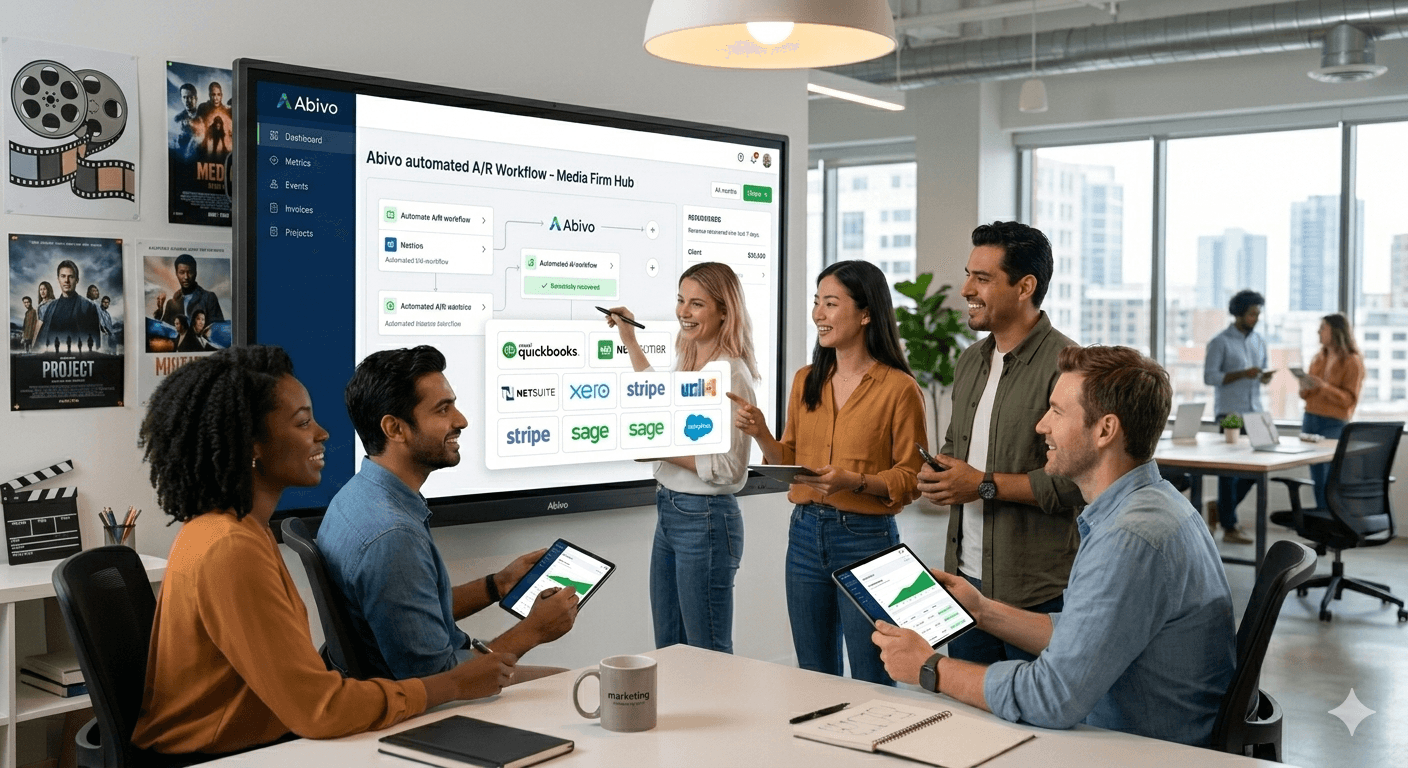
Abivo connects to the field service and accounting tools construction firms already run, including ServiceTitan, BuildOps, Jobber, QuickBooks and NetSuite, so follow-up runs on live invoice data with no double entry. For a real example from the trades, read the OFS Group case study, a fire protection and commercial appliance service company.
If you want the deeper playbook, start with our guide to collections software for construction contractors, or see how to export an A/R aging report from Sage 100 Contractor to find out where your balances sit today.
Practical Takeaways for Construction and Engineering Firms
Treat every pay app as an invoice with its own follow-up, starting before the submission cutoff.
Track retainage as a separate receivable with a closeout date and a named contact.
Get change orders priced and signed before you bill them.
Call the person who approves the work first, then the person who releases the payment.
Put small service invoices on the same follow-up rhythm as project billing, so they stop aging in the background.
Specialty trades have their own guides: collections software for electrical contractors and collections software for plumbing contractors.
Frequently Asked Questions
What is a normal DSO for a construction company?
Credit Pulse's benchmarks put construction at 60 to 90 days. A number above that range usually points to retainage that was never chased or pay apps stuck in approval, rather than customers who cannot pay.
How do you collect retainage faster?
Start the retainage request before closeout, not after it. Confirm the completion date, list the documents the customer needs, send them together, and follow up on a set date with the held amount stated plainly.
Who should a subcontractor follow up with about a late payment?
The party you contracted with, usually the general contractor. Start with the project accountant, bring in the project manager if the pay app is not approved, and escalate to the controller if a promised date passes.
Can an AI agent call a general contractor about a pay app?
Yes. Kate asks whether the pay application was received and approved, asks for the expected payment date, logs the answer, and passes anything disputed to your team with the conversation history.
Want follow-up that keeps every pay app, retainage balance and service invoice moving? Get Started.