Cultural Differences in Business Payments: What to Know in A/R
Master global A/R with our guide on cultural payment norms. Learn how Abivo's AI agents adapt to US, EU, and Asian markets to recover revenue faster.

Sia Ghazvinian
Co-Founder & CEO

Table of contents
Share
The global economy has evolved into a hyper-connected ecosystem where goods and services cross borders with increasing fluidity. Yet, the financial infrastructure and cultural behaviors that underpin these transactions have not homogenized at the same pace. For businesses operating on net terms, particularly service-based small and medium-sized businesses (SMBs) and mid-market enterprises, the challenge of Accounts Receivable (A/R) is no longer just about arithmetic. It is about anthropology.
The assumption that a due date carries the same weight in Tokyo as it does in Berlin, or that a collection email should sound the same in New York as it does in São Paulo, is a strategic error that costs businesses billions annually in delayed revenue and broken relationships. Research indicates that cross-border payments take 55% longer to settle than domestic ones, creating a significant “cash flow gap” that threatens the liquidity of scaling firms.
This comprehensive report explores the intersection of culture, economics, and psychology in global B2B payments. It provides a detailed analysis of regional payment behaviors across North America, Europe, Asia, and Latin America. It examines the “Working Capital Squeeze” of 2024-2025, where high interest rates and economic uncertainty are driving companies to delay payments as a form of cheap financing. Most importantly, it outlines how modern financial technology, specifically AI-powered automation platforms like Abivo, enables businesses to navigate these complexities at scale. By leveraging AI calling and email agents that adapt to local languages, time zones, and cultural nuances, finance teams can recover revenue faster while preserving the client relationships that drive long-term growth.
The New Reality of Global Accounts Receivable
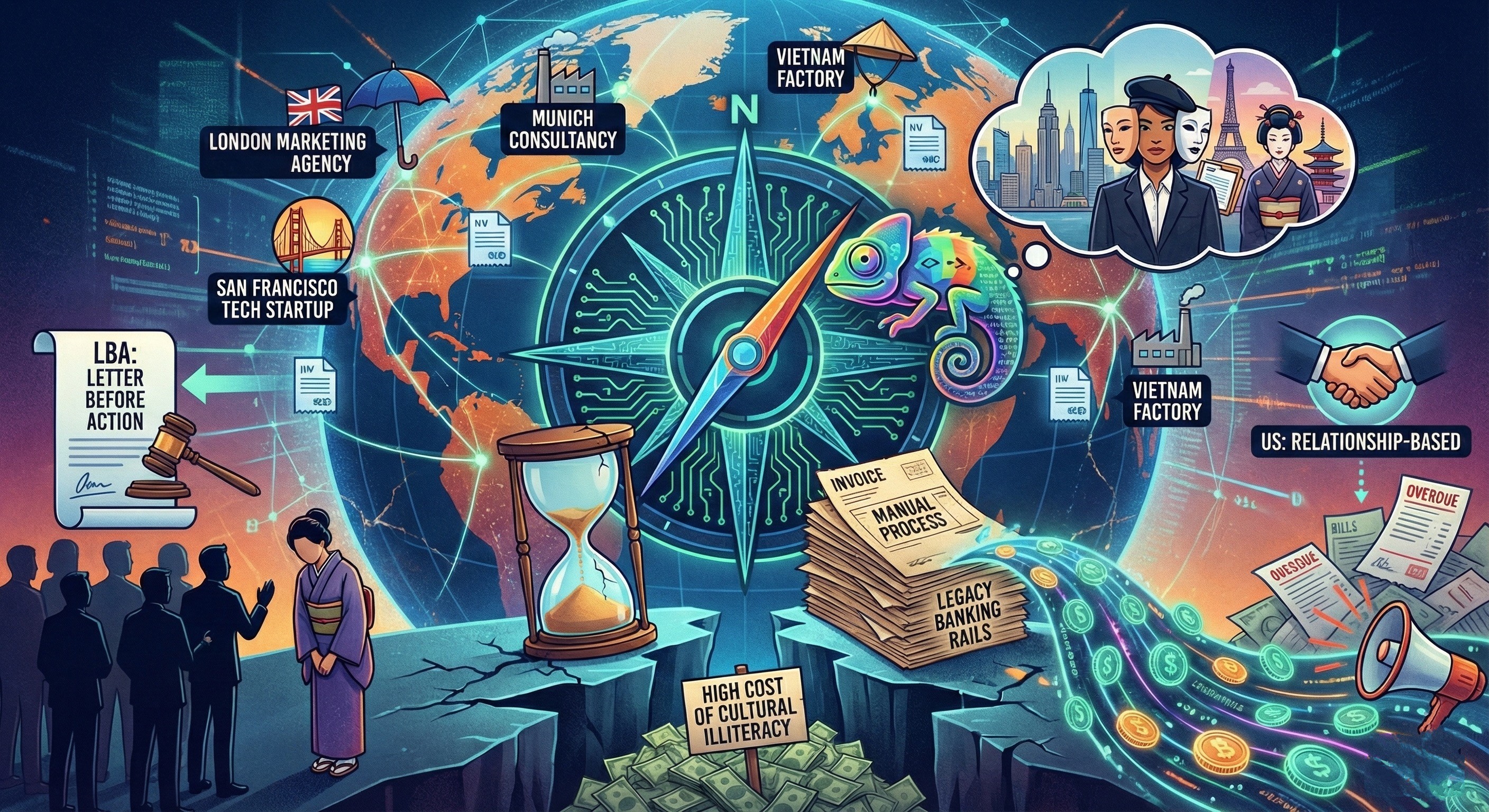
The Globalization of the SMB Service Sector
Historically, cross-border trade was the domain of multinational conglomerates with armies of credit controllers and local legal teams. Today, the digital revolution has democratized global business. A marketing agency in London can serve a tech startup in San Francisco. A specialized manufacturing consultancy in Munich can guide a factory in Vietnam. A medical clinic in a tourism hub might invoice insurance providers across three continents.
However, this expansion brings a hidden complexity. When a business starts issuing 500 or more invoices a month to a disparate client base, the manual processes that worked for local clients begin to fracture. The finance team is no longer just chasing payments; they are navigating a labyrinth of unwritten social contracts.
The data supports this view of increasing friction. Global B2B payment volumes exceed $120 trillion annually, yet the systems managing these flows remain surprisingly antiquated. While consumer payments have become instant and invisible, business payments are often tethered to legacy banking rails and manual approvals. This disconnect is exacerbated by the “Working Capital Squeeze.” In 2024, global Working Capital Requirements (WCR) rose to 76 days of turnover, the highest level since 2008. This means companies are holding onto their cash longer than ever before, using their suppliers as a line of credit.
The High Cost of Cultural Illiteracy
For a creditor, ignorance of local norms is expensive. A collection strategy that is effective in one market may be disastrous in another.
Consider the “Letter Before Action” (LBA). In the United Kingdom, this is a standard, formalized step in the debt recovery process that signals seriousness without necessarily escalating to immediate hostility. Sending such a letter to a UK client is a recognized procedural move. However, sending a similarly legalistic demand to a long-standing partner in Japan could be perceived as a catastrophic breach of trust, causing the client to withdraw into silence to “save face” rather than pay the bill.
Conversely, taking a “soft,” relationship-based approach in a market like the United States, where efficiency and leverage dictate payment speed, might result in your invoice drifting to the bottom of the pile. In the US, the “squeaky wheel gets the grease,” and a lack of direct follow-up is often interpreted as a lack of urgency.
The challenge for the modern AR professional is to be a cultural chameleon. They must be firm and litigious in New York, polite and bureaucratic in Paris, and humble and patient in Tokyo. For high-volume businesses, executing this mental switching manually for every invoice is impossible. This is the gap that AI automation seeks to fill.
Theoretical Framework of Payment Culture

To understand why payment behaviors differ, we must look beyond the spreadsheet to the psychological and sociological drivers of debt.
The Concept of Time: Linear vs. Flexible
Cultures perceive time differently, which directly impacts the definition of a “Due Date.”
Linear Time (Monochronic): In cultures such as Germany, the United States, and Scandinavia, time is viewed as a scarce resource. It is linear, segmented, and tangible. “Time is money.” In these cultures, a deadline is a fixed point. Missing it is a sign of inefficiency or disrespect. An invoice due on the 30th is expected to be paid by the 30th.
Flexible Time (Polychronic): In cultures such as Latin America, Southern Europe, and parts of the Middle East, time is fluid. Relationships and human interaction take precedence over strict schedules. A deadline is often viewed as an objective or a target rather than a binding constraint. An invoice due on the 30th might be paid on the 45th, and this is considered within the realm of acceptable business conduct, provided the relationship remains strong.
The Perception of Debt: Sin vs. Strategy
The moral weight of owing money varies significantly across borders.
Debt as Sin/Guilt: In German, the word for debt (Schuld) is the same as the word for guilt. This linguistic link reflects a deep-seated cultural aversion to being in the red. Paying on time is a moral imperative.
Debt as Strategy: In the United States and the UK, debt is a financial instrument. It is leverage. Large companies often delay payments to smaller suppliers not because they can’t pay, but because their treasury departments have calculated that holding the cash yields a better return on capital. It is strictly business.
Debt as Shared Responsibility: In Asian cultures heavily influenced by Confucian values, such as China and Vietnam, debt operates within the web of Guanxi (relationships). A debt is not just a financial transaction but a link in a chain of mutual obligation. Aggressively calling in a debt can sever that link.
High-Context vs. Low-Context Communication
This distinction, pioneered by anthropologist Edward T. Hall, is critical for drafting collection emails.
Low-Context (Explicit): In the US, Canada, Australia, and Northern Europe, communication is direct. You say what you mean. A collection email can be short: “Invoice #123 is overdue. Please remit payment.” The recipient appreciates the clarity.
High-Context (Implicit): In Japan, China, Arab cultures, and Latin America, the message is embedded in the context. Direct confrontation is avoided. You rarely state “You are late.” Instead, you might say, “We are reviewing our records and cannot seem to locate the transaction.” The recipient understands the subtext perfectly without suffering the indignity of a direct accusation.
Regional Deep Dive, North America (USMCA)
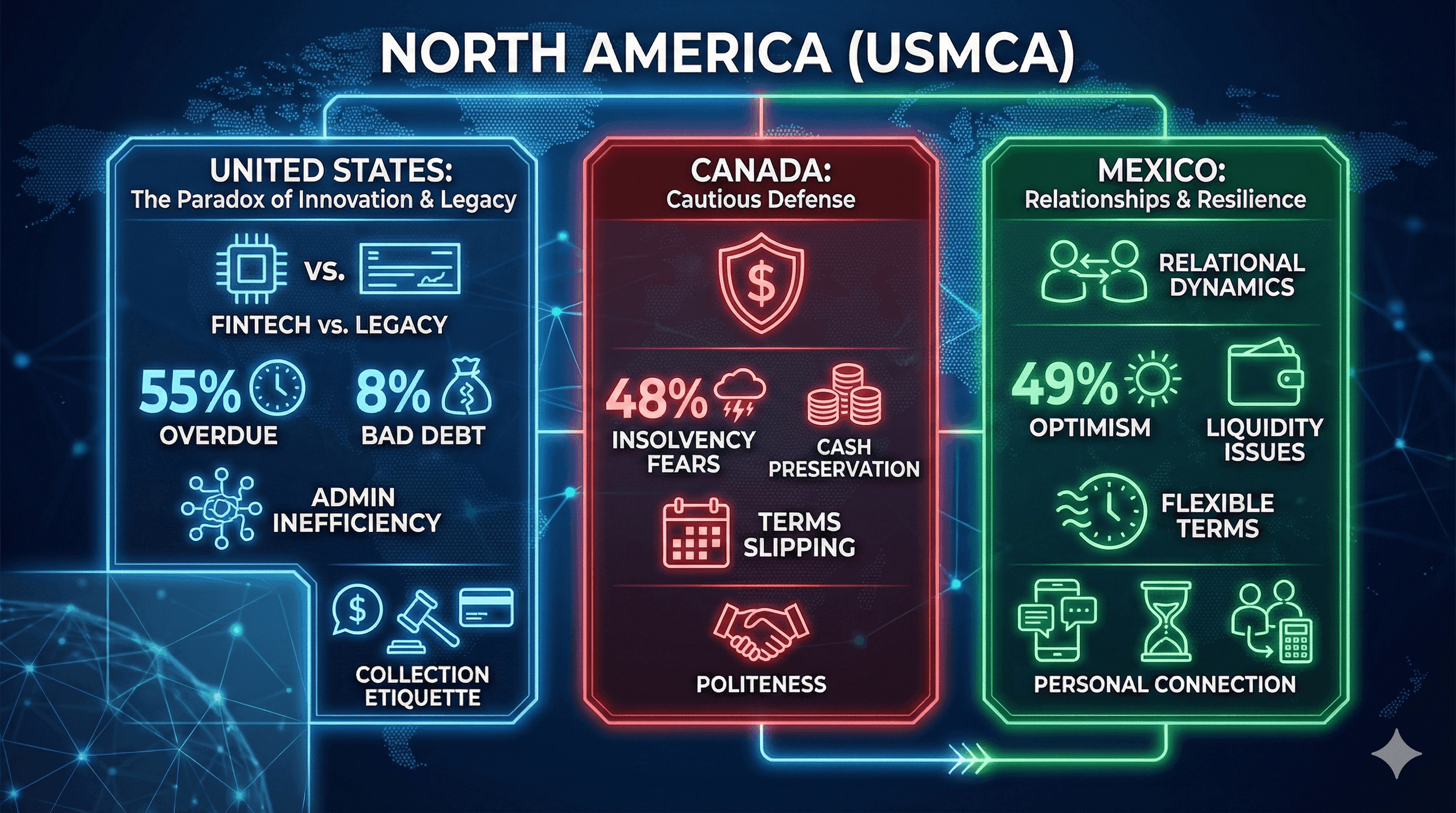
The North American block serves as a study in contrasts, housing three distinct business cultures under one trade agreement.
The United States: The Paradox of Innovation and Legacy
The United States is often characterized as a “borrower-friendly” jurisdiction. The cultural narrative of the “American Dream” supports risk-taking, and bankruptcy is often viewed as a mechanism for a fresh start rather than a moral failing.
Payment Behavior: Despite being a global fintech hub, the US B2B payment landscape is surprisingly reliant on legacy systems. A significant portion of transactions are still conducted via paper check, though this is shifting toward ACH and commercial cards.
Late Payments: 55% of all B2B invoiced sales in the US are overdue.
Bad Debt: Bad debts average 8% of B2B credit sales, a figure that imposes considerable strain on working capital.
Drivers: The primary reason cited for late payments is administrative inefficiency. Invoices get lost in complex AP portals or stuck in approval workflows.
Collection Etiquette: US business culture is transactional and fast-paced.
Directness: It is acceptable to be direct. “Time is money.” Automated reminders are effective because they are viewed as helpful nudges rather than personal insults.
Litigation: The US is litigious. While legal action is a last resort due to cost, the threat of it is a standard tool in the collector’s arsenal.
Technology: US clients expect friction-less payment options. If you offer a “Pay Now” link for a credit card, many will use it simply to clear the task from their to-do list, even if it incurs a small fee.
Canada: The Conservative Northern Neighbor
While culturally similar to the US, Canada operates with a higher degree of caution.
Payment Behavior: Canadian firms are currently operating in a defensive mode.
Insolvency Fears: 48% of Canadian companies anticipate an increase in insolvencies in the coming year.
Cash Preservation: In response to economic uncertainty, Canadian businesses are deferring investment plans and delaying payments to their own suppliers.
Terms: Payment terms are generally standard (Net 30), but adherence is slipping as companies hoard cash to buffer against a potential recession.
Collection Etiquette: Politeness is paramount in Canada. The aggressive, litigious tone that might work in New York can be perceived as abrasive in Toronto or Vancouver. The approach should be professional, firm, but courteous.
Mexico: Relationships and Resilience
Mexico introduces the relational dynamics typical of Latin American business culture.
Payment Behavior:
Optimism: Unlike their Canadian counterparts, Mexican firms often express optimism about the insolvency landscape, with 49% expecting stability.
Liquidity Issues: The primary driver for delays in Mexico is customer cash flow issues. Companies often want to pay but are waiting on their own receivables.
Collection Etiquette:
Personal Connection: Business is personal. A generic email from a “no-reply” address is easy to ignore. A WhatsApp message or a phone call to a specific contact in the finance department is far more effective.
Patience: The definition of “on time” has more variance. Building a relationship with the Contador (accountant) is often the most effective collection strategy.
Regional Deep Dive, Western Europe

Europe presents a distinct “North-South” divide in payment culture, further complicated by diverse legal frameworks.
The United Kingdom: The Pressure Cooker
The UK market is currently navigating significant economic headwinds, including high inflation and the lingering complexities of post-Brexit trade.
Payment Behavior:
Late Payment Crisis: Late payments affect 40% of B2B sales in the UK.
Insolvency Anxiety: There is widespread worry about insolvencies, particularly in the construction sector, where bad debts are rising.
Creditor Rights: Historically, the UK has been a “creditor-friendly” jurisdiction, prioritizing the rights of those owed money over the protection of the debtor.
Collection Etiquette:
Formal Process: The UK follows a structured path. It begins with polite reminders, escalates to a formal “Letter Before Action” (LBA), and can proceed to the “Small Claims Track” for debts under £10,000.
Understatement: British communication relies on understatement. A “gentle reminder” is understood to be a demand. Aggressive language is frowned upon until the relationship is deemed irretrievable.
Germany: The Efficiency Engine
Germany is the benchmark for payment discipline in Europe.
Payment Behavior:
Schuld (Debt/Guilt): The cultural aversion to debt drives prompt payment.
Skonto: The practice of offering an early payment discount (e.g., 2% discount for payment within 10 days) is standard. German finance teams are highly motivated to capture these discounts to demonstrate efficiency.
DSO Trends: Even Germany is feeling the global strain, with DSO increasing by +5 days recently.
Collection Etiquette:
Directness: German business communication is fact-based and direct. There is no need for extensive small talk. State the invoice number, the amount, and the due date.
Formal Titles: Use proper titles (Herr, Frau, Dr.) in correspondence until invited to be informal.
France: The Administrative Labyrinth
France combines a modern economy with a love for hierarchy and administration.
Payment Behavior:
WCR Increase: France has seen a sharp increase in Working Capital Requirements (+8 days), indicating a slowdown in payment cycles.
Centralized Decisions: Payment approval often rests with senior management. Delays are frequently caused by an invoice sitting in a signature stack rather than a lack of funds.
Collection Etiquette:
Relationships: Business lunches and long-term relationships are vital. Collections should handle the relationship with care (“taking care of the partner”).
Language: While many French professionals speak English, communicating in French (or having flawless translations) signals respect and can expedite processing.
Southern Europe (Italy, Spain): The Long Game
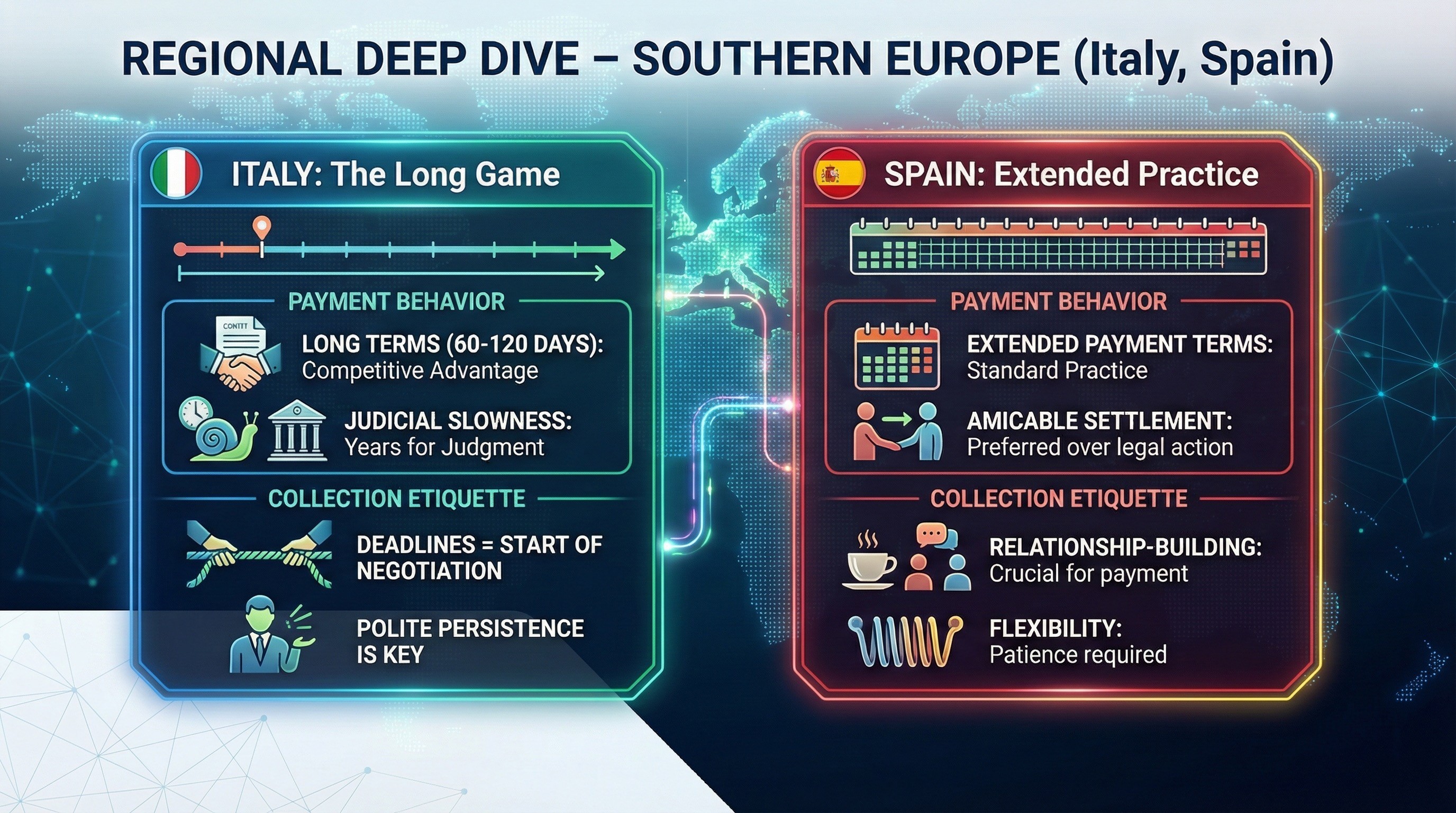
In Southern Europe, extended payment terms are standard practice.
Payment Behavior:
Sales Tool: In Italy, offering long payment terms (60, 90, 120 days) is often used as a competitive tool to win business.
Judicial Slowness: The legal systems in Italy and Greece are notoriously slow for debt recovery. A court judgment might take years, making amicable settlement the only practical option.
Collection Etiquette:
Negotiation: Deadlines can be viewed as the start of a negotiation. Persistence is required, but it must be polite persistence.
Regional Deep Dive, Asia Pacific
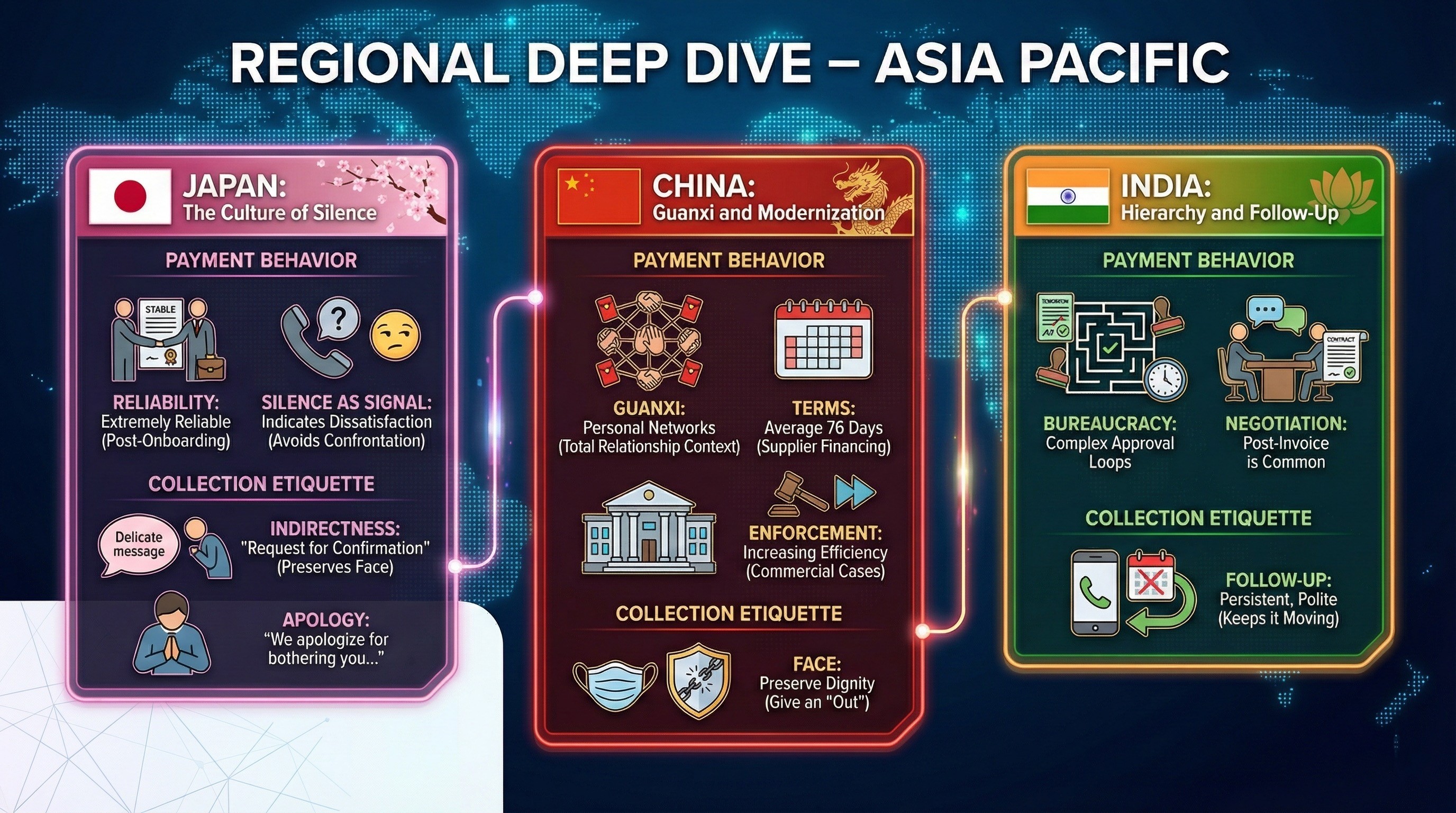
The Asian market operates on principles of social harmony and “face” that are fundamentally different from Western norms.
Japan: The Culture of Silence
Japan is a high-context culture where social harmony (Wa) is paramount.
Payment Behavior:
Reliability: Japanese firms are generally extremely reliable payers once a relationship is established. However, the onboarding and approval process can be lengthy.
Silence as Signal: If a Japanese client stops responding, it is rarely due to disorganization. It is often a signal of dissatisfaction. They are avoiding the confrontation of telling you there is a problem with the service.
Collection Etiquette:
Indirectness: You must never aggressively demand payment or accuse the client of being late. This causes a loss of face. The inquiry must be framed as a “request for confirmation” or a “check of internal records.”
Apology: It is common to apologize for the intrusion of asking for money. “We apologize for bothering you during your busy schedule…”.
China: Guanxi and Modernization
China is a rapidly evolving market where traditional values meet modern scale.
Payment Behavior:
Guanxi: Business runs on personal networks. A debt is often viewed within the context of the total relationship.
Terms: Payment terms have lengthened (average 76 days) as companies use suppliers to manage working capital amid economic slowdowns.
Enforcement: Contrary to stereotypes, the Chinese legal system has become increasingly efficient for debt enforcement in commercial cases.
Collection Etiquette:
Face: Similar to Japan, preserving the debtor’s dignity is crucial. Give them an “out” (e.g., blaming the banking system) so they can pay without admitting fault.
India: Hierarchy and Follow-Up
Payment Behavior:
Bureaucracy: Invoices often get stuck in complex approval loops.
Negotiation: Post-invoice negotiation is not uncommon.
Follow-Up: “Tomorrow” is a flexible concept. Persistent, polite follow-up is necessary to keep the invoice moving through the system.
Regional Deep Dive, Latin America (Brazil)
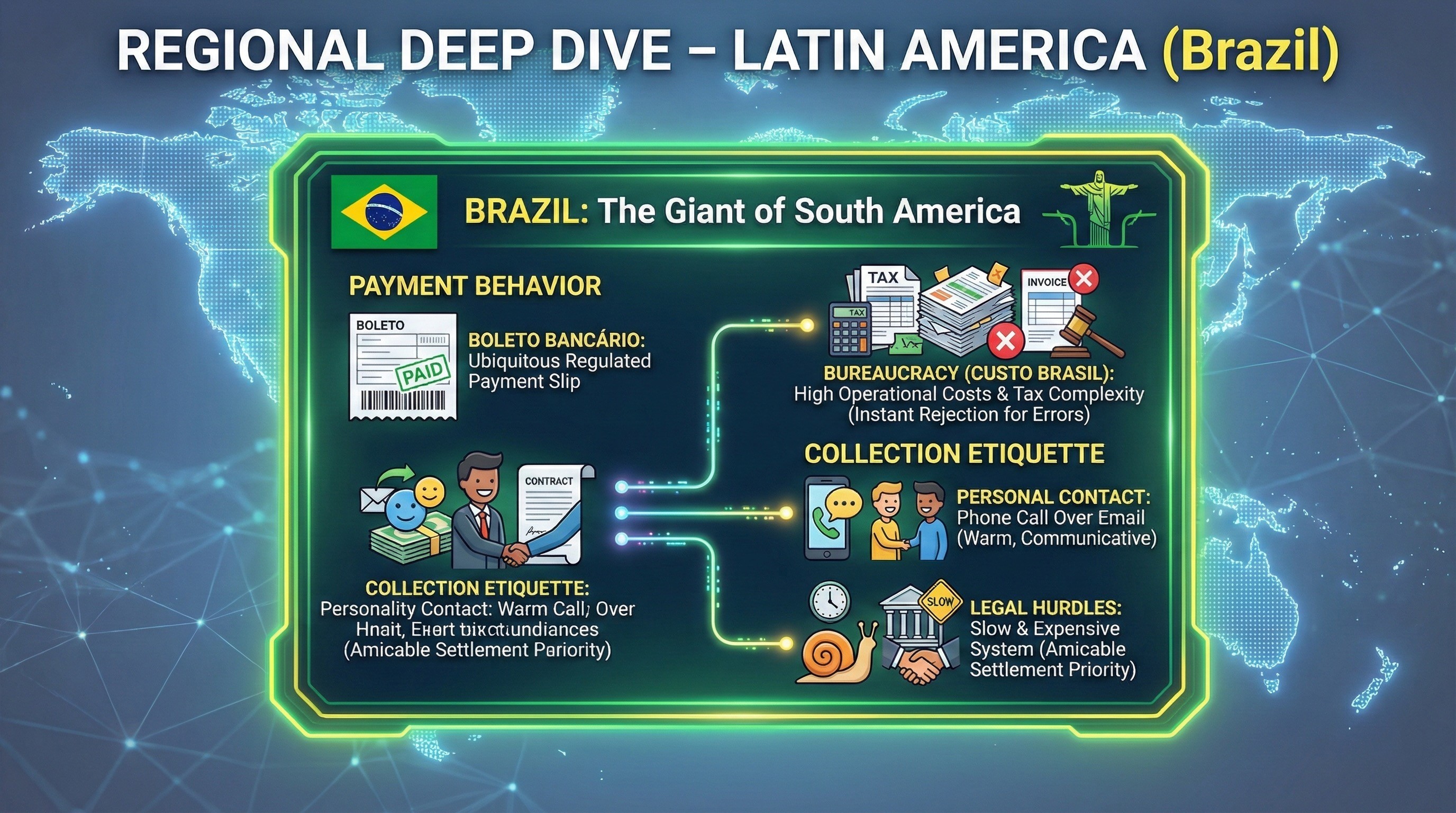
Brazil is the giant of South America, with a unique payment ecosystem.
Payment Behavior:
Boleto Bancário: The Boleto is a regulated payment slip system that is ubiquitous in Brazil. Many businesses prefer paying via Boleto over wire transfers or cards.
Bureaucracy (Custo Brasil): The “Brazil Cost” refers to the high operational costs of doing business, including complex tax codes. If an invoice has a minor error in a tax calculation, it will be rejected immediately.
Collection Etiquette:
Personal Contact: Brazilians are warm and communicative. A phone call is infinitely more effective than an email.
Legal Hurdles: The legal system is slow and expensive. Amicable settlement is the priority.
The Mechanics of Friction, Why Payments Fail
Beyond culture, systemic friction points slow down global AR.
The Tyranny of Time Zones
For an AR team in California chasing a client in Sydney, the “sunlight gap” is a major hurdle. When the US team arrives at 9 AM, it is 2 AM in Sydney. A simple email exchange to clarify an invoice line item can take a week of back-and-forth due to the lack of overlapping working hours.
Solution: Asynchronous automation. AI agents that can send emails or make synthesized calls during the debtor’s business hours are essential for closing this gap.
The Language Barrier
English is the language of global business, but it is not necessarily the language of every Accounts Payable clerk.
Translation Fatigue: In markets like Japan, Russia, or France, an invoice or reminder in English adds cognitive load to the recipient. It requires translation and interpretation. This friction makes it easier to put the invoice at the bottom of the pile.
Misinterpretation: Legal terms in English can sound threatening when translated literally. A “Final Notice” might translate to a declaration of war in a high-context culture.
Banking Rails and Currency
Fees: Cross-border wires are expensive (average 1.5% fee) and slow.
Short Payments: Payments often arrive net of intermediary bank fees. If an invoice is for $1,000 and the wire arrives as $985, automated AR systems might flag the account as “partially paid,” triggering unnecessary collections activity and annoying the client.
The Role of AI Automation, The Abivo Solution
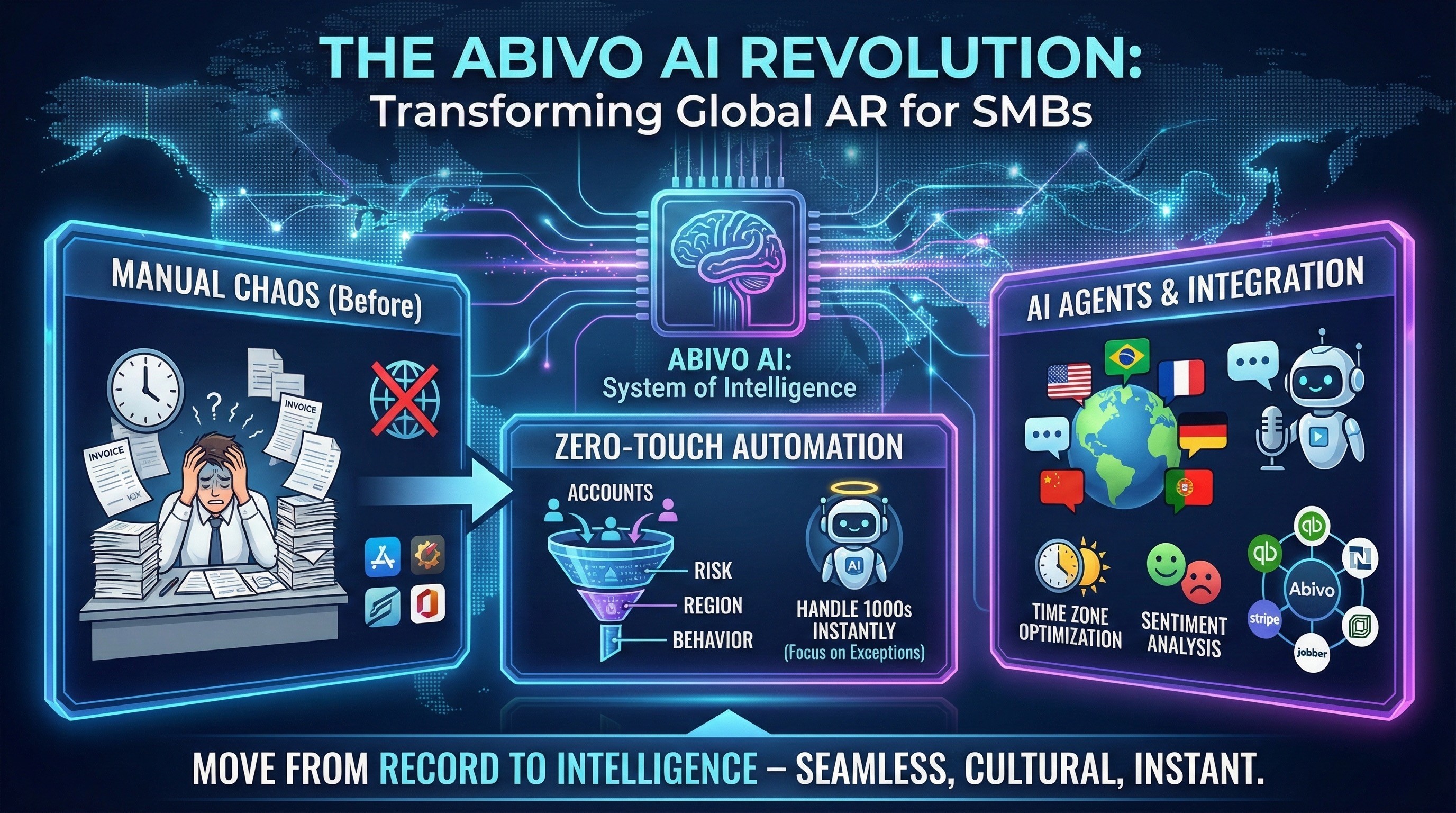
For a service-based SMB managing 500+ invoices a month across multiple borders, manual management of these cultural and technical variables is impossible. You cannot hire a collections specialist for every language and time zone.
This is where AI-powered automation platforms like transform the landscape. Abivo moves AR from a “System of Record” to a “System of Intelligence.”
The “Zero-Touch” Philosophy
Abivo is designed for high-volume environments. Its “Zero-Touch” capability handles thousands of accounts instantly, categorizing them by risk, region, and behavior without human intervention. This allows the finance team to focus only on high-value exceptions.
AI Agents as Cultural Chameleons
Abivo’s AI agents solve the specific friction points identified in this report:
Multi-Language Fluency: The AI agents can communicate via email and voice in multiple languages (e.g., Spanish, French, German, Mandarin, Portuguese). This allows a US firm to chase a Brazilian client in Portuguese, drastically increasing engagement.
Time Zone Optimization: The AI monitors the debtor’s location and schedules outreach for their local business hours, ensuring the message arrives when they are at their desk.
Sentiment Analysis: The AI analyzes incoming responses. If a Japanese client replies with subtle hesitation, the AI detects the sentiment and can flag it for human review rather than sending a tone-deaf automated follow-up.
Seamless Integration
Automation is only as good as the data it sits on. Abivo integrates directly with the platforms that service-based SMBs use:
Accounting/ERP: QuickBooks, NetSuite, Xero, Sage Invoicing, Microsoft Dynamics, SAP Business One / Ariba.
Payments: Stripe, Square Invoices, Bill.com.
Field Service: Jobber, ServiceTitan, BuildOps.
Invoicing: FreshBooks.
This integration ensures that when a payment clears in Stripe or a bank feed updates in NetSuite, the collections cadence stops immediately, preventing the embarrassment of chasing a paid invoice.
Practical Playbook for International AR
Based on the research, here is a strategic framework for managing global AR.
The “Traffic Light” Segmentation
Do not treat all international clients the same. Segment them:
Green Zone (Efficiency): US, UK, Canada, Australia, Germany, Netherlands.
Strategy: Automated, direct, fast. Use credit card links. Short cadences.
Yellow Zone (Relational): France, Italy, Spain, Mexico, Brazil.
Strategy: Personalized automation. Longer intervals between reminders. Emphasis on “checking in.” Use WhatsApp integration where possible.
Red Zone (High Context): Japan, China, Middle East.
Strategy: Highly polite, indirect language. “Request for confirmation” instead of “Demand.” Escalation involves senior-to-senior outreach, not legal threats.
Optimize Your “Ask”
Currency: Invoice in the client’s local currency if possible to reduce their friction.
Data: Ensure the invoice contains every piece of data required by local law (VAT number, tax ID, PO number). In Brazil or Italy, a missing code makes the invoice legally unpayable.
Timing: Align your automated reminders with local pay cycles. In many European countries, payment runs happen once a month (often the 10th or 25th). Chasing on the 15th is futile.
Leverage Technology
Self-Service Portals: Provide a portal where clients can download their own invoices and statements. This solves the time zone issue of “Can you resend the invoice?”.
AI Agents: Deploy Abivo agents to handle the low-level chase. Let the AI send the polite Japanese email at 3 AM your time.
Future Trends
The future of payments is moving toward “Embedded Finance” and “Real-Time Intelligence.”
Predictive Insolvency: AI will not just chase debt; it will predict it. By analyzing payment patterns across millions of invoices, platforms will warn you before you sign a contract that a prospect in the UK has a high probability of default.
Generative AI Negotiation: We will see AI agents that can negotiate payment plans within pre-set parameters. “I see you are having cash flow issues. We can accept 50% now and 50% in 30 days. Shall I update the terms?”.
Global E-Invoicing Mandates: Governments (France, Poland, Malaysia) are mandating electronic invoicing to close VAT gaps. Compliance will become an automated feature of AR platforms.
Conclusion
In the modern global economy, a sale is not a sale until the money is in the bank. But the journey from “Invoice Sent” to “Payment Received” is a journey through culture, psychology, and geography.
For the finance leader at a growing service-based business, the goal is not to become an expert in the insolvency laws of 50 countries. The goal is to build a system that acts like one. By combining deep cultural awareness with the scalability of AI automation platforms like , businesses can bridge the cash flow gap. They can turn the friction of cross-border payments into a competitive advantage, proving that while business is global, the ability to connect, and collect, is universal.