From Closed Won to Paid in Full: Aligning Sales and A/R
Sales closes the deal. A/R collects the payment. When these teams don't talk, cash flow suffers. Here's how to fix it.

Soham Gawde
Business Analyst

Table of contents
Share
In many businesses, there is a distinct line drawn in the sand. On one side stands the sales team, focused on revenue growth, closing deals, and hitting quotas. On the other side is the accounts receivable (AR) team, focused on risk mitigation, cash flow, and collecting payments. While both teams ultimately want the company to succeed, their methods often put them at odds.
This friction usually manifests in a scenario familiar to many finance professionals. A salesperson closes a massive deal and rings the victory bell. The company celebrates the new revenue. However, three months later, the AR team is still struggling to collect the first payment because the customer was not vetted for creditworthiness, or the payment terms promised during the sale were vague.
The “throw it over the fence” mentality, where sales hands off a new client to finance without context, is a primary driver of high Days Sales Outstanding (DSO) and cash flow volatility.
For service-based businesses, trades, and companies managing high volumes of invoices, this alignment is not just about office politics. It is about financial survival. Bridging the gap between sales and AR ensures that a “closed won” deal actually converts to cash in the bank.
The Cost of the Silo Mentality

When sales and AR operate in silos, the company suffers from what is known as the “revenue illusion.” Revenue is booked on the income statement, but if it is not collected, it is merely a vanity metric.
The disconnect often stems from conflicting incentives. Sales teams are typically compensated based on signed contracts or booked revenue. Their goal is volume and speed. Conversely, AR teams are evaluated on collection speed and bad debt reduction. Their goal is security and accuracy.
A study by HubSpot indicates that misalignment between internal teams costs companies trillions of dollars a year in lost productivity and wasted effort. When sales reps are not aware of a client’s payment history, they might aggressively upsell a customer who is already ninety days past due. This digs the hole deeper.
Furthermore, the customer experience suffers. A client might receive a warm, enthusiastic check-in call from their account executive in the morning, only to receive a stern, cold demand letter from the finance department in the afternoon. This “good cop, bad cop” routine is rarely coordinated, leaving the customer confused and frustrated.
Establishing a Unified “Quote-to-Cash” Mindset
To fix this, leadership must shift the focus from two separate processes, sales and collections, to a single, continuous lifecycle known as “Quote-to-Cash.”
In this model, the sale is not considered complete when the contract is signed. It is considered complete when the funds clear the bank.
Pre-Qualification and Credit Policies
The alignment must begin before a proposal is ever sent. Sales teams need clear guidelines on who they are allowed to sell to and under what terms.
AR leaders should provide the sales team with a simple credit policy framework. This does not mean sales reps need to become financial analysts, but they should understand the basics of a credit check.
If a prospect has a history of late payments or poor credit, the sales rep should know this immediately. In some modern CRM setups, this data can be flagged automatically. This allows the sales rep to adjust the conversation. Instead of offering standard Net 30 terms, they might require a deposit upfront or a shorter payment cycle.
This proactive approach filters out bad debt before it enters the ecosystem. It saves the AR team from chasing uncollectible invoices later, and it saves the sales team from wasting time on deals that will eventually be clawed back from their commissions.
Clarity in Contract Terms
Vague language in contracts is a nightmare for collections teams. A handshake agreement or a verbal promise of “pay when you can” makes the invoice almost impossible to enforce.
Sales and AR must collaborate on a standard set of payment terms. These terms should be non-negotiable without approval from a finance leader. Key elements to standardize include:
Payment due dates: Are they Net 15, Net 30, or due on receipt?
Late fee policies: Will interest be charged on overdue balances?
Acceptable payment methods: Does the company accept credit cards, checks, or ACH only?
Billing contacts: Who exactly receives the invoice?
This last point is often overlooked. A salesperson usually deals with a decision-maker or a champion within the client company. However, that person is rarely the one paying the bills. If the sales rep fails to get the email address of the accounts payable department, the invoice lands in the wrong inbox and sits there for weeks.
The Critical Handoff: Information Sharing

The transition from prospect to customer is the most vulnerable point in the relationship. This is the moment where critical data is often lost.
To streamline this, businesses should implement a structured “onboarding handoff.” This acts as a checklist that sales must complete before the account is officially turned over to the finance/operations team.
The checklist should include more than just the billing address. It should include the nuance of the relationship. Did the customer mention they have a specific billing cycle? Do they require a purchase order (PO) number on every invoice?
When AR teams have to call a new customer to ask for a PO number that should have been captured during the sales process, it delays payment and makes the vendor look disorganized.
Integrating the Tech Stack
Technology plays a massive role in facilitating this transfer of knowledge. In many organizations, sales lives in a CRM (like Salesforce or HubSpot), while AR lives in an ERP or accounting system (like QuickBooks, Xero, or NetSuite).
If these systems do not talk to each other, the teams cannot talk to each other efficiently.
Integration ensures that notes made by the AR team regarding payment status are visible to the sales team. If an account manager pulls up a client profile in the CRM to prepare for a renewal conversation, they should see a flashing red light if that client is significantly overdue.
According to a report by Deloitte, organizations that prioritize digital transformation and data visibility across functions are significantly better at forecasting and cash management. When data flows freely, the sales rep becomes an ally in collections rather than an obstacle. They can leverage their relationship to gently nudge the client, often resolving issues faster than a formal collections email could.
The Role of Automation in reducing Friction

While human collaboration is essential, manual coordination has its limits. This is where automation platforms like Abivo become the bridge that stabilizes the relationship between sales and finance.
Automation removes the emotional labor and administrative burden from the collections process. In a traditional setup, if a payment is late, the AR specialist has to manually draft an email or make a phone call. If they are overwhelmed, they might pressure the sales rep to intervene. The sales rep, fearing they will damage the relationship, resists. Tension builds.
An automated system neutralizes this conflict. Intelligent agents can handle the routine follow-ups, payment reminders, and even phone calls without human intervention.
How AI Supports the Sales Relationship
It might seem counterintuitive, but automating collections actually protects the sales relationship.
When an AI agent handles the transactional aspect of following up on an invoice, it depersonalizes the request. The “bad guy” is the system, not the human account manager.
If the issue escalates and requires human intervention, the sales rep or AR specialist steps in only when necessary, armed with a complete transcript of the attempts made so far.
Furthermore, tools like Abivo integrate directly with the accounting platforms used by service businesses, such as ServiceTitan, Jobber, or Sage. This ensures that the data being acted upon is real-time. There is no risk of an automated call going out to a customer who paid five minutes ago, which is a common source of embarrassment for sales teams.
Creating a Feedback Loop

Alignment is not a one-time project; it is an ongoing loop. The most successful finance teams use data from the collections process to inform future sales strategies.
This is often called a “post-mortem” on bad debt. When an invoice is written off or sent to third-party collections, the AR and sales leaders should review what happened.
Was the red flag visible during the prospecting phase?
Did we agree to terms that were too loose?
Did the scope of work expand without a corresponding deposit?
By analyzing these failures, the organization can tighten its criteria. Perhaps the data shows that clients in a specific industry or below a certain revenue threshold are consistently late payers. Marketing and sales can then adjust their targeting to avoid these prospects in the future.
Shared KPIs and Incentives
Finally, nothing drives behavior like compensation. While it is unfair to penalize a salesperson for a client’s inability to pay months down the road, it is reasonable to tie a portion of their commission to cash collection.
Some organizations structure commissions so that 50% is paid upon signing and 50% is paid upon the first invoice clearing. This ensures the salesperson has a vested interest in the client’s creditworthiness and the accuracy of the billing information.
Alternatively, companies can create shared KPIs (Key Performance Indicators). If the company achieves a certain reduction in DSO or an improvement in working capital, the entire revenue team, sales and finance, receives a bonus. This fosters a culture where cash flow is everyone’s responsibility.
Tactics for Immediate Alignment
If your organization is currently suffering from a disconnect between these two critical functions, you do not need to wait for a massive restructuring to make improvements. Here are practical steps you can take immediately:
Weekly “At-Risk” Reviews: Schedule a brief 15-minute standup between AR and Sales leadership to review the top 10 overdue accounts. Transparency solves problems faster than email chains.
The “No-PO, No-Go” Rule: Empower the finance team to block the start of work or the shipment of goods if the purchase order number is missing from the contract.
Educational Lunch-and-Learns: Have the AR team present to the sales team on “ The Lifecycle of an Invoice.” Show them exactly what happens after they ring the bell. Explain the cost of capital and why net terms matter.
Unified Client View: If you cannot fully integrate your software yet, ensure sales has “read-only” access to the accounting software, or export a weekly aging report that is easy for them to read.
Moving Toward Financial Health
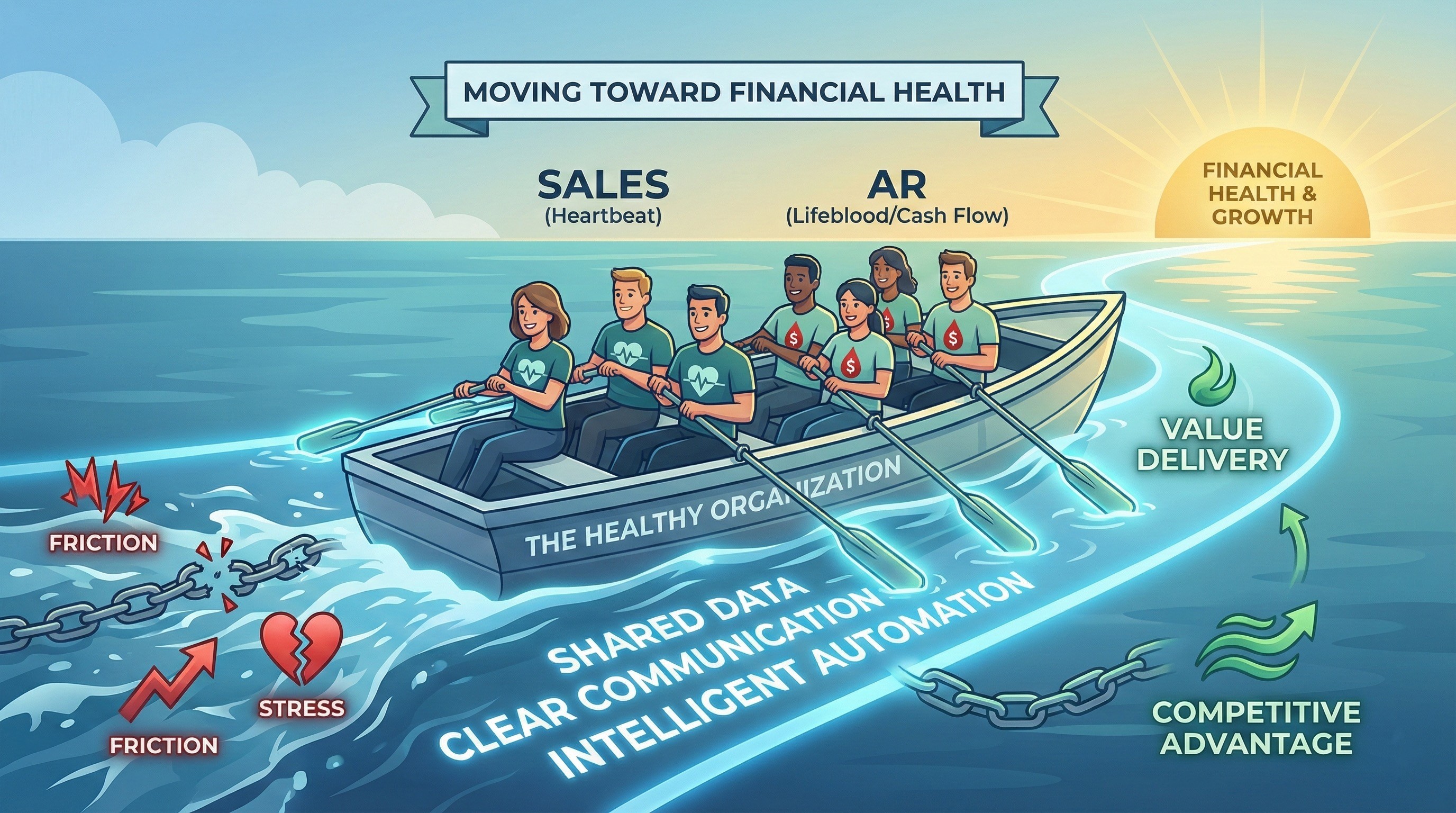
The goal of aligning sales and accounts receivable is not to turn salespeople into accountants, nor is it to turn collections specialists into deal-closers. The goal is to ensure that both teams are rowing in the same direction.
When sales sets the right expectations, and AR has the information they need to execute, the friction disappears. The conversation shifts from internal finger-pointing to external value delivery.
For businesses processing hundreds of invoices a month, particularly in the service and trade sectors, this alignment is the difference between struggling to make payroll and having the capital to invest in growth. By leveraging clear communication, shared data, and intelligent automation, you can transform your revenue cycle from a source of stress into a competitive advantage.
Cash flow is the lifeblood of business, but sales is the heartbeat. For a healthy organization, you need both to work in perfect rhythm.