Predictive Analytics in A/R: Anticipating Late Payments | Abivo
Stop chasing overdue payments. Predictive analytics forecasts late payments early, letting your team take action before cash flow suffers. Learn how AI transforms A/R.

Sia Ghazvinian
Co-Founder & CEO

Table of contents
Share
The Cash Flow Conundrum
Imagine finishing a complex project (perhaps a custom home renovation or a comprehensive legal audit) only to wait 60, 90, or even 120 days for payment. You have delivered the value, but the liquidity required to pay your staff and vendors remains locked in an outstanding invoice. This scenario is the reality for millions of service-based businesses. Recent data reveals that over 50% of B2B invoices in the US are overdue, and the average small business is owed more than $17,000 in unpaid receivables.
For service-based SMBs (such as construction firms, medical clinics, and professional services agencies) this is not just an inconvenience; it is a threat to operational stability. Traditional Accounts Receivable (AR) management is reactive. It waits for a due date to pass before triggering an action. However, in an economy where cash flow is the primary driver of survival, waiting is no longer a viable strategy. The solution lies in shifting from a reactive stance to a proactive one using predictive analytics. By leveraging data to anticipate delinquency before it happens, businesses can secure their revenue streams and maintain healthy client relationships.
The Rearview Mirror vs. The Crystal Ball
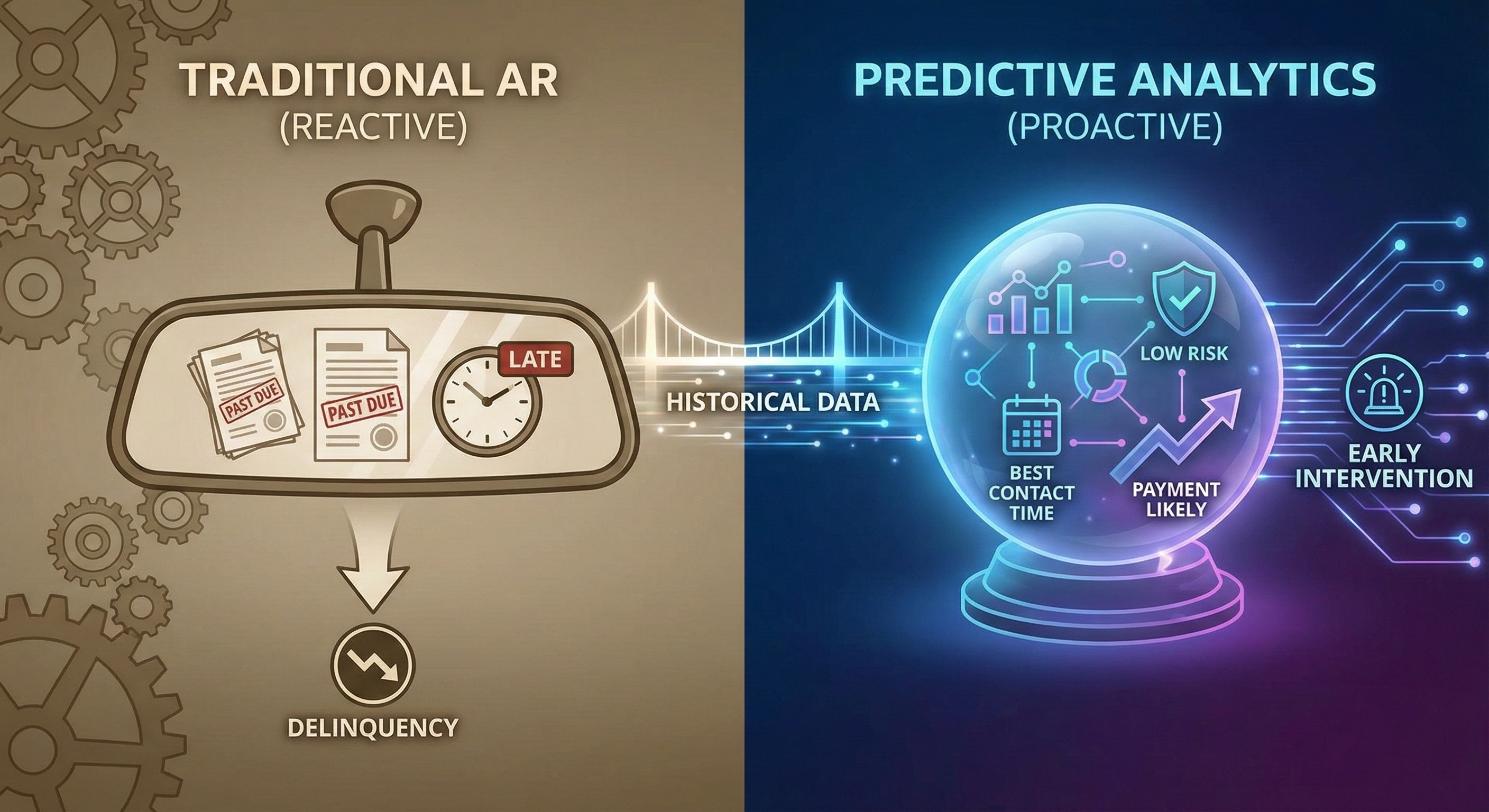
To understand the power of predictive analytics, we must first look at how AR has traditionally functioned. Historically, collections teams operated based on aging reports. These reports act like a rearview mirror; they tell you what has already happened. A client is 30 days late, so you send a reminder. They are 60 days late, so you make a call. This approach is inefficient because it treats every late payer the same, ignoring the nuances of why they are late or when they are likely to pay.
Predictive analytics changes the vantage point. Instead of looking backward, it uses historical data and behavioral patterns to look forward. It answers critical questions such as:
Which customers are likely to pay on time?
Who is at risk of defaulting next month?
What is the best day and time to contact this specific client?
By analyzing factors like payment velocity, dispute history, and even email engagement (did they open the invoice?), predictive models generate a “risk score” for every account. This allows finance teams to intervene early, often before the invoice is even due, preventing the delinquency from occurring in the first place.
How Predictive Modeling Works in Practice
Predictive analytics might sound like science fiction, but it is grounded in tangible data that your business likely already generates. Modern AR automation platforms, like Abivo.ai, aggregate data from your existing systems (whether you use QuickBooks, Xero, or industry-specific tools like Jobber and ServiceTitan) to build a comprehensive picture of your financial health.
1. Historical Payment Analysis The system looks at how a client has behaved in the past. If a client consistently pays 14 days after the due date, the model predicts this pattern will continue. This insight allows you to adjust your cash flow forecast accuracy, ensuring you are not counting on money that will not arrive until next month.
2. Behavioral Signals Predictive models also analyze digital body language. For example, if a client usually opens your invoice email within an hour but hasn’t opened the latest one for three days, the system flags this as a risk. It might indicate the invoice landed in spam or the contact person has left the company.
3. External Factors Advanced models can incorporate external data, such as macroeconomic trends or industry-specific risks. If interest rates rise or a specific sector faces a downturn, the model adjusts the risk scores for clients in those industries, prompting you to tighten credit limits or request deposits.
Tailoring the Approach: Industry-Specific Applications
Predictive analytics is not a “one size fits all” solution. Its real value emerges when applied to the specific workflows of different service industries.
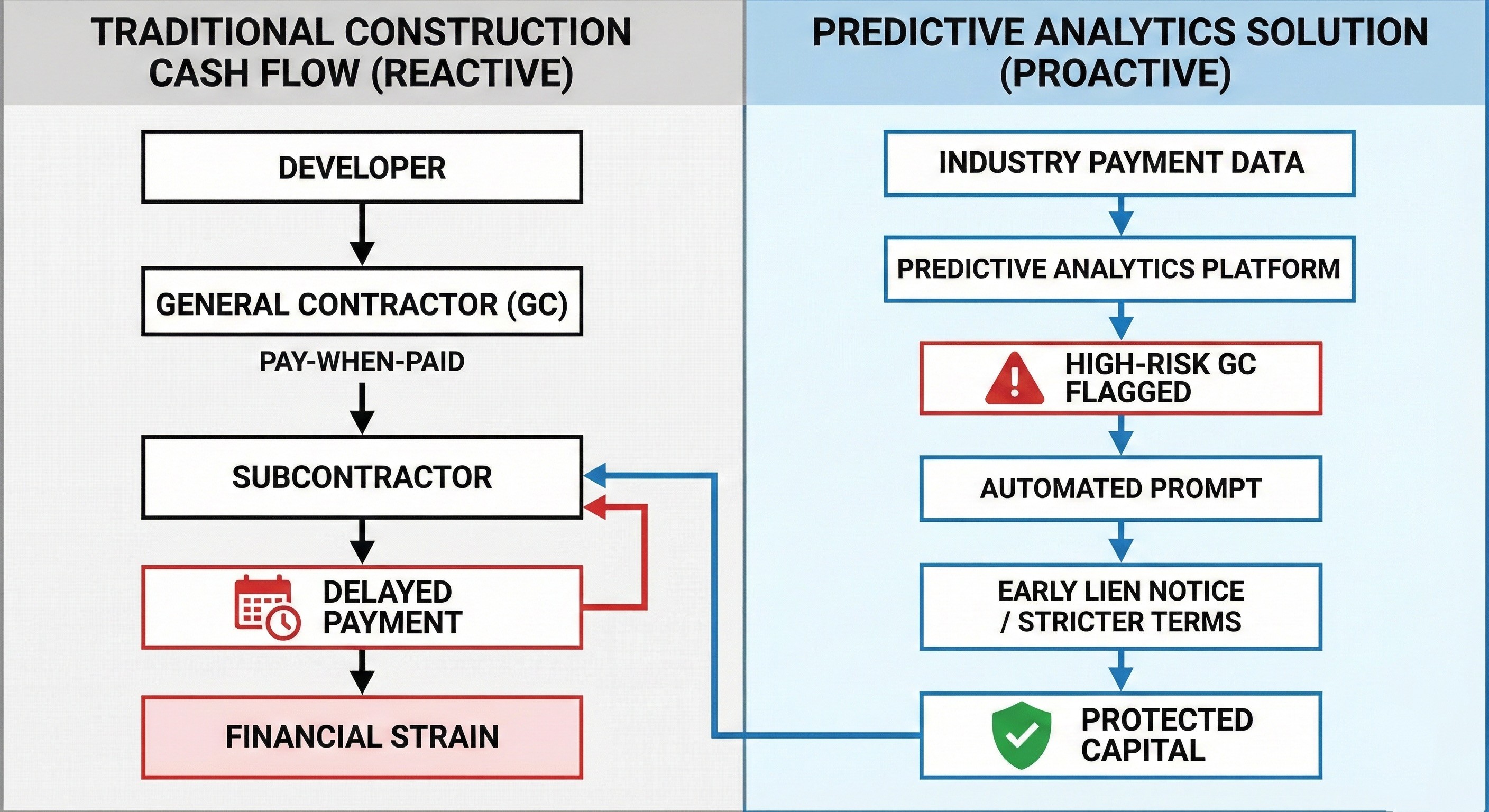
Construction and Trades Cash flow in construction is notoriously complex due to “pay-when-paid” clauses and project-based billing.
The Challenge: A general contractor might delay payment because they haven’t been paid by the developer, causing a ripple effect down to subcontractors.
The Predictive Solution: By analyzing payment trends across the industry, predictive models can flag general contractors who are showing signs of financial stress. If a project is flagged as high-risk, an automation platform can prompt you to send preliminary lien notices earlier or enforce stricter payment terms for future milestones. This foresight prevents you from overextending your own capital on materials for a job that might not pay out.
Medical and Healthcare For medical practices, the battle is often against insurance denials and rising patient responsibility.
The Challenge: Denials cost providers roughly $118 per claim to rework, and patient collections are becoming harder as deductibles rise.
The Predictive Solution: Analytics can predict the likelihood of a claim denial based on payer history and coding patterns. It can also score a patient’s “propensity to pay,” allowing front-desk staff to collect copays or set up payment plans at the point of service rather than chasing bad debt months later.
Professional Services Agencies and firms often deal with “scope creep” and disputes that delay payment.
The Challenge: Clients may withhold payment because they are unhappy with a deliverable or surprised by the final bill amount.
The Predictive Solution: By monitoring project “burn rates” (how fast budget is used) against invoicing, predictive tools can alert account managers when a project is veering off track. A pre-emptive conversation about budget overruns can prevent the invoice dispute that would otherwise occur a month later.
The Role of AI Agents
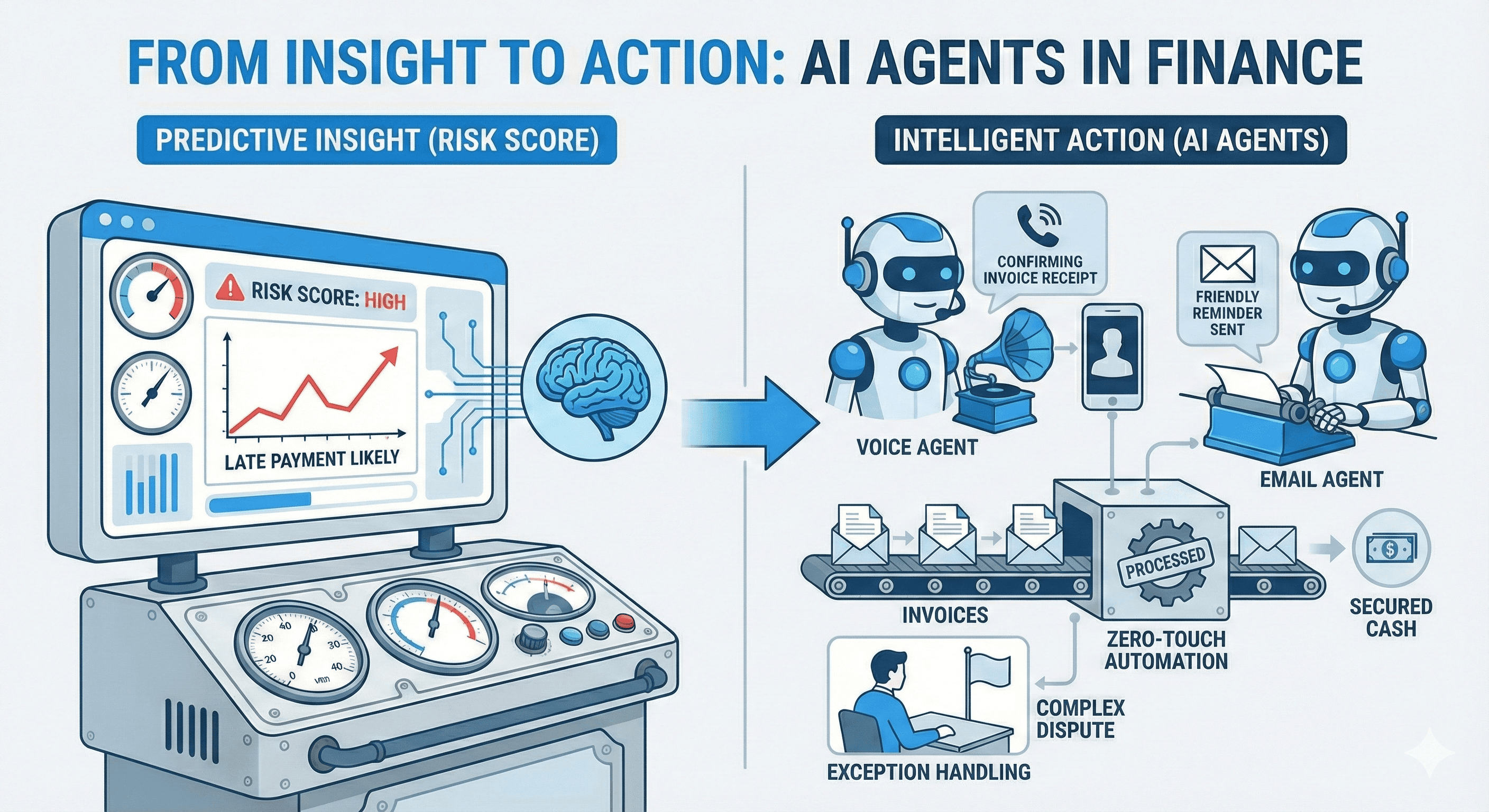
Knowing a payment will be late is valuable, but acting on that knowledge is what secures the cash. This is where the synergy between predictive analytics and Autonomous Finance comes into play. Platforms like Abivo do not just display a risk score; they act on it.
Intelligent Outreach Instead of a human collector manually dialing numbers, AI agents (capable of both voice and email communication) can initiate contact based on the predictive triggers.
Low-Risk Scenario: If a reliable client is predicted to be late due to a simple oversight, the AI agent sends a gentle, friendly email reminder.
High-Risk Scenario: If a client’s risk score spikes, the AI agent can make a phone call to confirm invoice receipt and ask for a payment date. These agents are trained to be polite yet persistent, preserving the human relationship while ensuring the business gets paid,.
Zero-Touch Automation For the vast majority of invoices, this process requires no human intervention. The system detects the invoice creation in your ERP (e.g., NetSuite or Microsoft Dynamics), predicts the optimal follow-up cadence, and executes it. Human team members are only brought “in the loop” when a complex dispute arises that requires high-level judgment. This “Zero-Touch” approach allows SMBs to scale their revenue without needing to hire a massive army of accounts receivable clerks.
Practical Takeaways
Implementing predictive analytics does not require a data science degree. Here are actionable steps to get started:
Clean Your Data: Predictive models rely on accurate history. Ensure your customer contacts, past payment records, and invoice details are correct in your accounting software.
Segment Your Customers: Do not treat everyone the same. Use your data to group clients into “Fast Payers,” “Slow but Reliable,” and “High Risk.” Tailor your communication strategy for each group.
Start with Integration: Choose an automation platform that integrates natively with your existing tech stack (e.g., ServiceTitan for trades, Bill.com for general finance) to ensure data flows seamlessly.
Monitor the “Burn”: For project-based work, track work-in-progress (WIP) against client credit limits. Use analytics to stop work before you accumulate too much exposure with a risky client.
Automate the Nudge: Use software to send reminders before the due date. A simple “friendly reminder” sent 3 days before an invoice is due can reduce late payments significantly.
How Abivo Fits In
At Abivo, we understand that for service-based businesses, every day of delayed payment matters. Our platform is built to bridge the gap between your accounting software and your bank account. By integrating with platforms like QuickBooks, Xero, Jobber, and BuildOps, Abivo ingests your financial data to power intelligent AI agents.
These agents don’t just send generic spam; they use predictive insights to determine the right message and the right time for each customer. Whether it is a polite email nudge or a professional voice call, Abivo handles the heavy lifting of collections so you can focus on delivering great service. We help you move from chasing invoices to predicting cash flow, turning your AR function into a strategic asset.
Conclusion
The era of waiting by the mailbox for a check is over. In 2025, the tools exist to predict payment behavior with remarkable accuracy. For service-based SMBs operating on tight margins, predictive analytics offers a path to financial stability. It allows you to anticipate delays, mitigate risks, and automate the manual grunt work of collections. By adopting these technologies, you are not just getting paid faster; you are building a more resilient, data-driven business that is prepared for whatever the economy brings next.