Receivable Challenges in Construction and Contracting: Tackling Long Payment Cycles, Retainage, and Progress Billing
Payment delays cost the construction industry $280 billion per year. Discover why progress billing and retainage create cash-flow crises and what contractors can do to accelerate receivables.

Pratheek Adi
Co-Founder & CTO

Table of contents
Share
The $280 B Payment Crisis in Construction
The construction industry is facing a cash-flow emergency few other sectors match. According to the 2024 Rabbet Construction Payments Report, slow payments cost the sector an estimated US$280 billion in 2024.
That figure reflects a deep-rooted systemic issue, in 2024, 82% of contractors reported payment delays over 30 days, compared with just 49% two years prior.
Delayed payments force many firms to rely on personal savings, credit cards or retirement funds to keep operations running; 95% of general contractors and 75% of subcontractors now “float” payments while awaiting developer disbursements.
For a mid-sized contractor juggling multiple jobs, the result is painful: you may complete work this quarter while still waiting on payment from last quarter. Meanwhile, payroll, materials and other expenses continue, turning the lag between work done and payment received from a cash-flow challenge into a survival issue.
Why Construction Payment Cycles Are Uniquely Broken
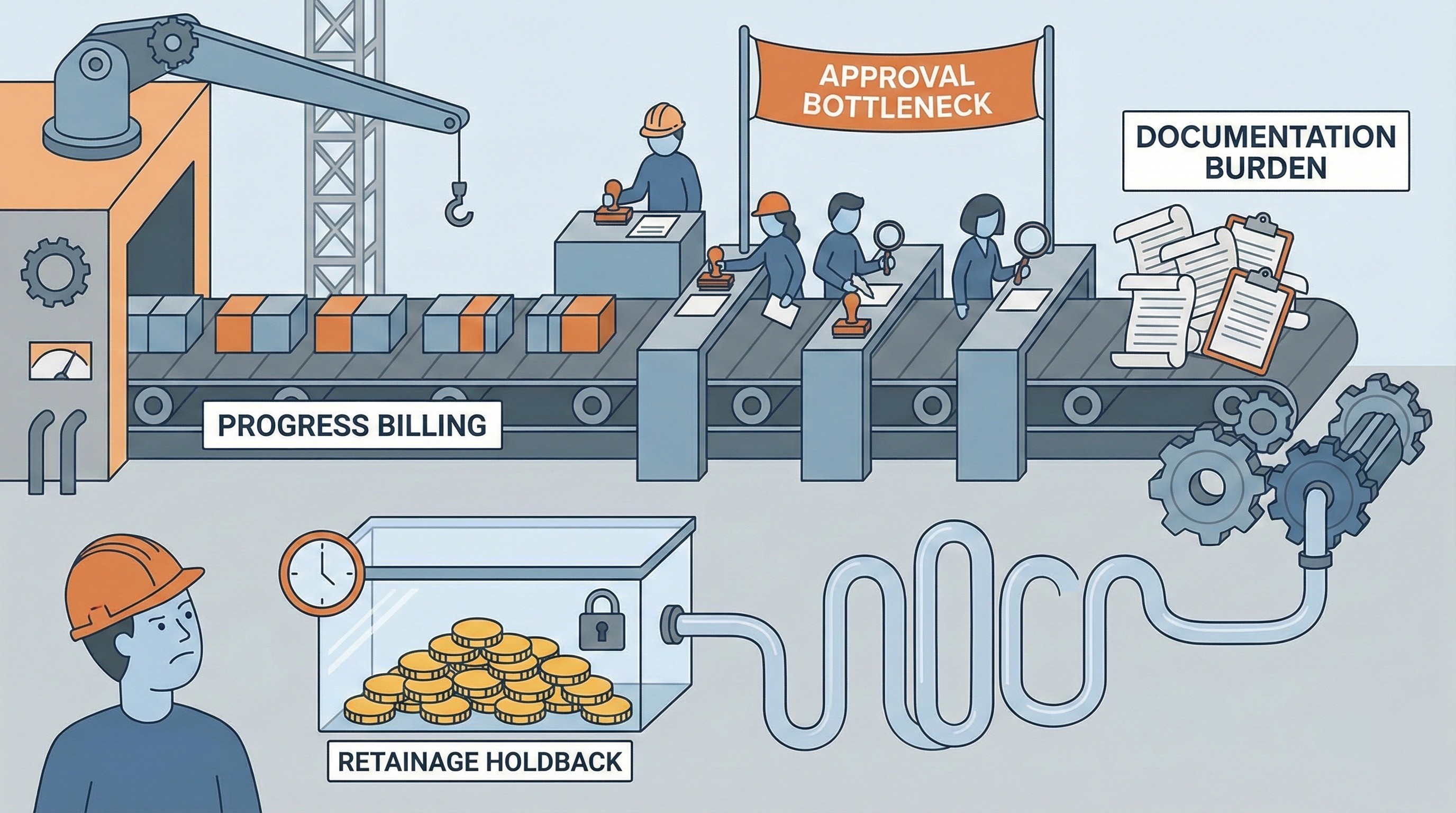
The way construction payments are structured, using progress billing and retainage, introduces friction that makes delayed money the norm rather than the exception.
Progress Billing Complications
Progress billing, submitting invoices incrementally based on work completed or milestones, is standard. On paper, it aligns payments with progress and helps manage cash flow. In practice, however, it creates friction at multiple stages.
Projects often involve many stakeholders: architects, project managers, owners’ reps. Each party must certify work, verify scope and quantities, often require site-inspections, and review documentation before approval. Any missing timesheet, delivery receipt, or incomplete certificate can stall an invoice for weeks.
Disagreements about work completion also add delays: for instance, a contractor might bill believing a milestone is 85% complete while the owner’s team assesses only 75%. That dispute can hold up not only that invoice, but all subsequent invoices until resolved.
Retainage: The Indefinite Holdback
Retainage, typically 5 to 10% held back from each payment until final project completion, adds long-term strain. That extra 5 to 10% might sit in limbo for 30 to 90 days after substantial completion, and sometimes much longer, before release. For a contractor, that means months of work without full payment. For subcontractors, the pain is worse: they often wait until the GC receives retainage before they themselves get paid.
This creates a payment pyramid where lower-tier contractors absorb financial risk while upper tiers control the timing of cash release. In an inflationary environment, withheld retainage loses real value over time, effectively eroding project margins.
Complex Approval Workflows and Documentation Burdens
Before a progress invoice can be approved, it typically must be supported by:
Progress photos or drone surveys showing work completed
Timesheets and labor-hour records from crews
Delivery receipts and material certificates
Approved change orders if scope changed
Lien waivers showing subcontractors/suppliers have been paid
Insurance and compliance documentation
When these items are scattered across spreadsheets, emails, cloud drives or various project teams, assembling a complete invoice becomes a multi-day (or even multi-week) effort. A single missing slip can hold up a six-figure invoice indefinitely.
The net effect: invoices sit in approval queues; cash remains locked; once-completed work becomes a liability, not an asset.
The Hidden Costs of Delayed Construction Payments
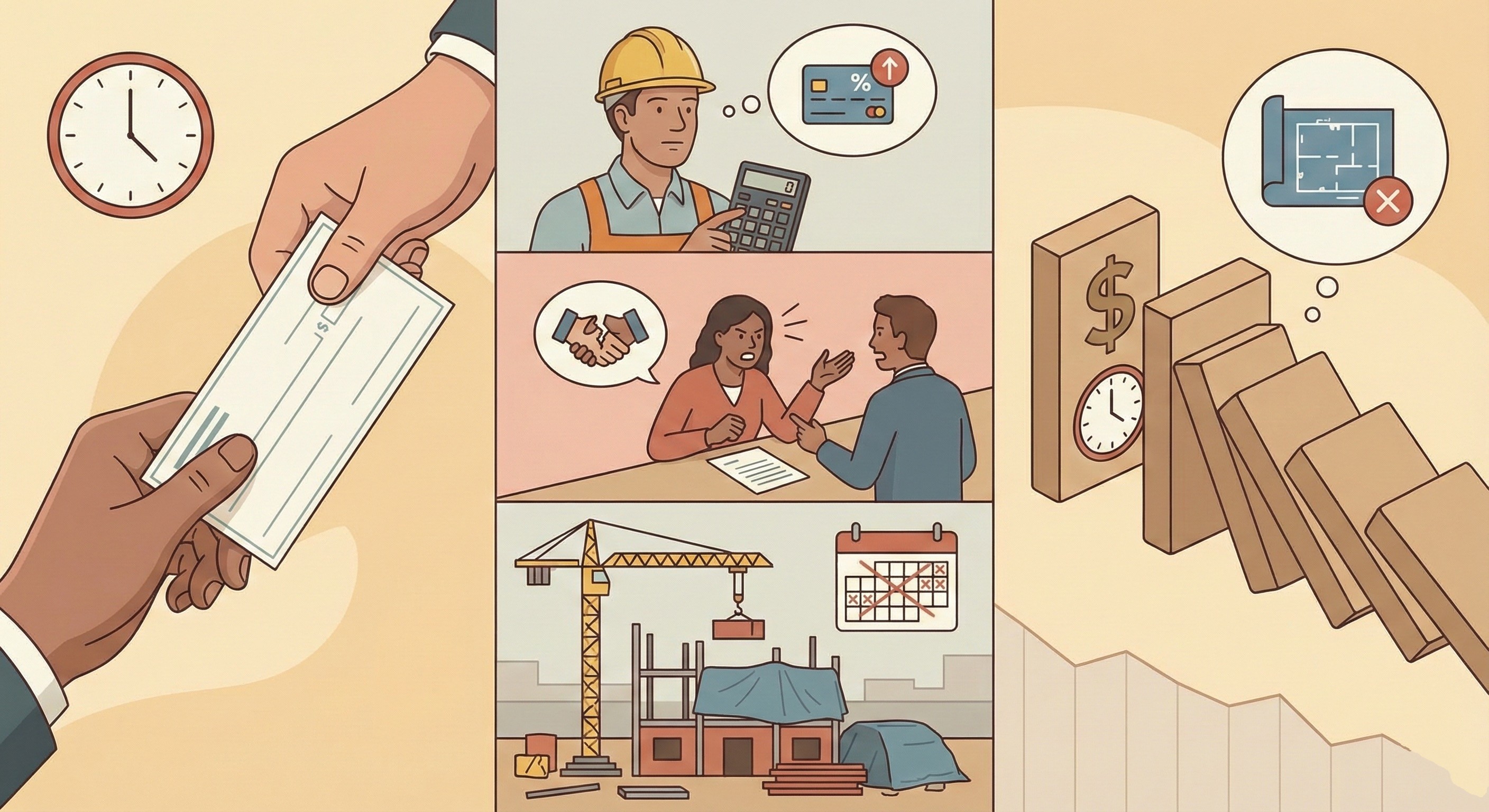
Delayed payments do far more than hold up cash, they create cascading financial damage.
Interest and Financing Costs Multiply
To stay afloat when payments are delayed, many contractors draw on credit lines or take loans to cover crew, materials, and overhead. With a typical delay stretching from 30 to 90 days, interest and fees add up: 3-5% on project costs isn’t uncommon. For smaller subcontractors with limited credit, interest rates can be steep, eating directly into tight margins.
Supplier & Subcontractor Relationships Deteriorate
When contractors can’t pay suppliers/subs on time, trust erodes quickly. Suppliers may start demanding deposits, stricter terms, or placing accounts on hold. Subcontractors will prioritize clients known for reliable payment, making top crews unavailable when you need them most.
Indeed, 100% of subcontractors surveyed consider a GC’s payment reputation when bidding. Over 75% admit they increase bid amounts to offset anticipated delays.
Delayed funding often causes ripple effects: material orders delayed, specialized equipment hire pushed back, leading to project schedule slippage and overtime costs.
Project Timeline Disruptions & Opportunity Costs
One delayed invoice can delay material procurement, which often derails project timelines. To make up lost time, firms may rush orders (costlier), shift resources among projects, or forgo other profitable work. Beyond direct cost, there’s lost opportunity: projects that could have been started or bid on may be postponed or abandoned.
Why Generic Invoicing Systems Fall Short in Construction
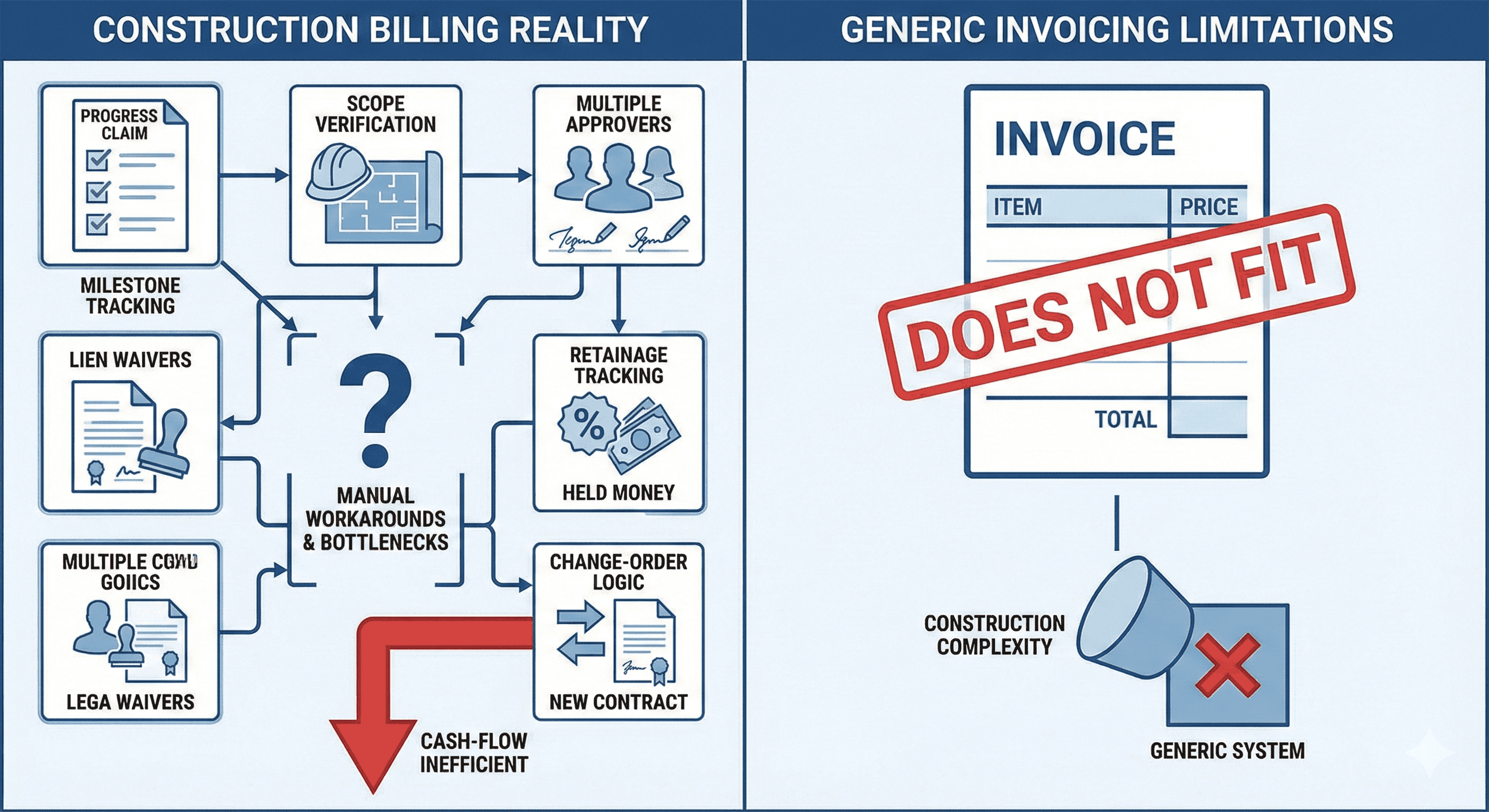
Standard invoicing or accounting systems, designed for simple billing of goods or services, don’t align with the complexity of construction billing. Progress claims require documentation, milestone tracking, scope verification, multiple approvers, lien waivers, retainage tracking, and change-order logic.
When firms shoe-horn construction billing into generic accounting tools, the result is manual workarounds, disconnected spreadsheets and bottlenecks, all of which kill cash-flow efficiency.
Best Practices to Improve Construction A/R
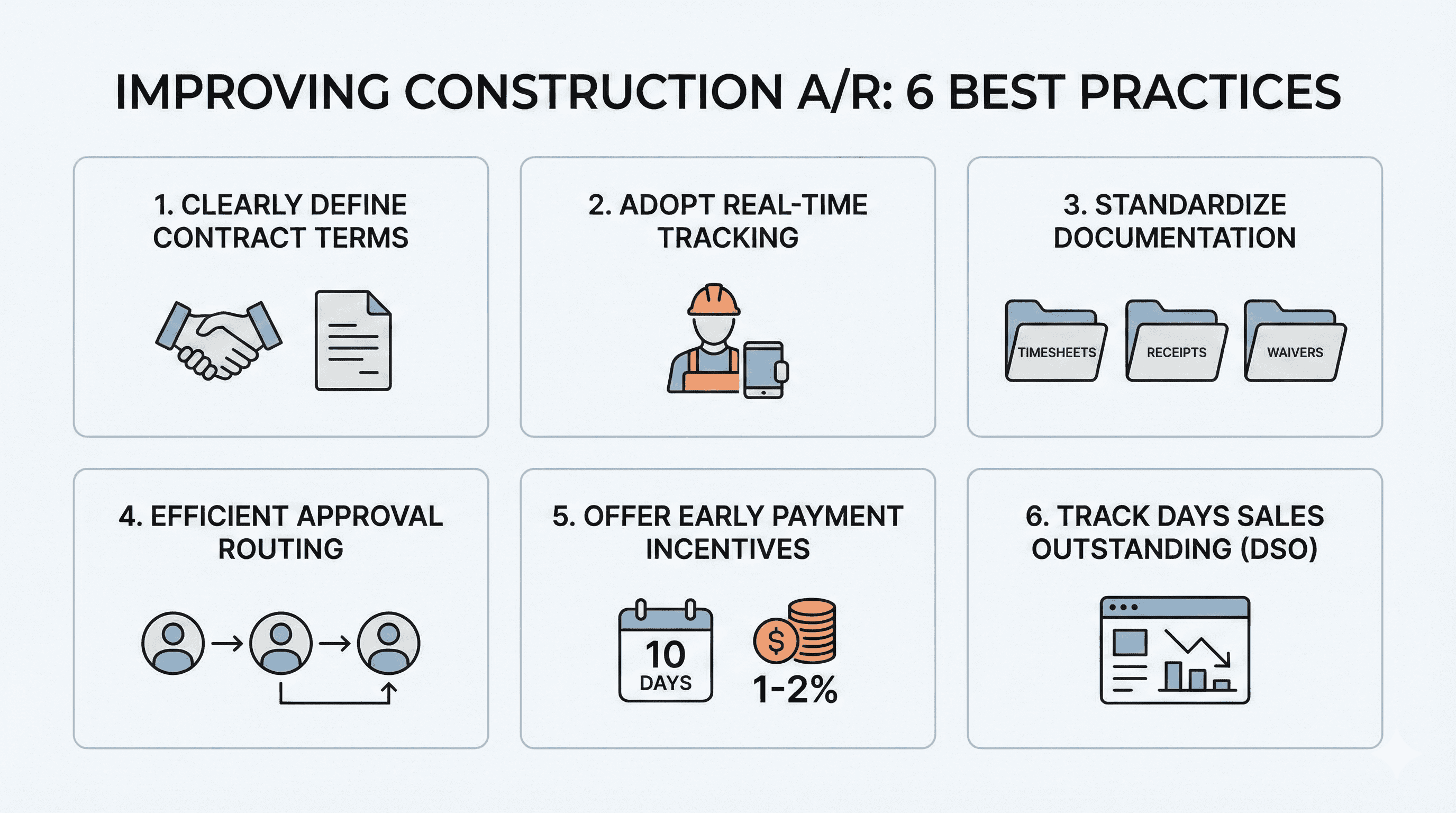
Here are best practices that help stabilize cash flow and accelerate receivables for construction firms:
1. Clearly Define Contract Terms Up Front
Contracts should include: scope and schedule-of-values (per-work-item breakdown), payment frequency and due dates, milestones and how they’ll be certified, change-order procedures, dispute-resolution mechanisms, and retainage amounts, release triggers, and timelines. Much payment conflict originates in ambiguous contract language, particularly around milestone definitions and “substantial completion.”
2. Adopt Real-Time Progress Tracking Technology
Use digital tools, progress photos, drone surveys, reality-capture or field reporting, to document work completion as it happens. Real-time, immutable records leave less room for dispute, and make billing more defensible. Using such technologies lets billing happen immediately when thresholds are met, rather than at end-of-month.
3. Standardize Documentation Across Teams
Establish naming protocols and required fields for timesheets, material deliveries, receipts, change orders and lien waivers at project kickoff. A consistent, enforceable documentation standard across field crews, subcontractors, project management, and finance simplifies invoice assembly and reduces friction.
4. Create Efficient, Transparent Approval Routing
Replace email threads and manual routing with formal workflows: assign each approval step to a particular role/person, with built-in deadlines and escalation paths. This way, every invoice has an accountable owner and a predictable path, no more lost emails or blame games.
5. Consider Early Payment Incentives
Offering a small discount (1 to 2%) for early payment (e.g., within 10 days) can meaningfully accelerate cash collection, particularly for large invoices where the discount is still material for the client. It can transform payment timing from an afterthought into a financially rational decision for the payor.
6. Track Days Sales Outstanding (DSO)
Track DSO (Accounts Receivable ÷ Credit Sales × Number of Days) monthly. Construction firms often operate at 70 to 90 days, far above healthy benchmarks. Monitoring DSO helps you spot when collection times are stretching out, so you can dive into which clients or projects are lagging and take corrective action.
How Automation Can Transform Construction A/R

Manual AR processes are costly and error-prone. That’s why software built for construction AR, integrating project data, drawing schedules, milestone tracking, retainage, and payment workflows, is growing in importance.
Such systems can:
Pull metrics directly from project management or drawing-log systems to prefill billing schedules.
Manage retainage tracking automatically so you know how much was withheld and when it becomes due.
Automate approval routing, reminders and escalation for overdue invoices.
Provide customer portals for clients to view invoices, certifications, lien waivers, and approve or dispute, improving transparency and reducing back-and-forth.
Log every action for audit, compliance or dispute resolution.
Firms that adopt construction-specific AR automation often see collection cycles significantly shorten and DSO improve as a result.
Moving Forward: A Path to Healthier Cash Flow
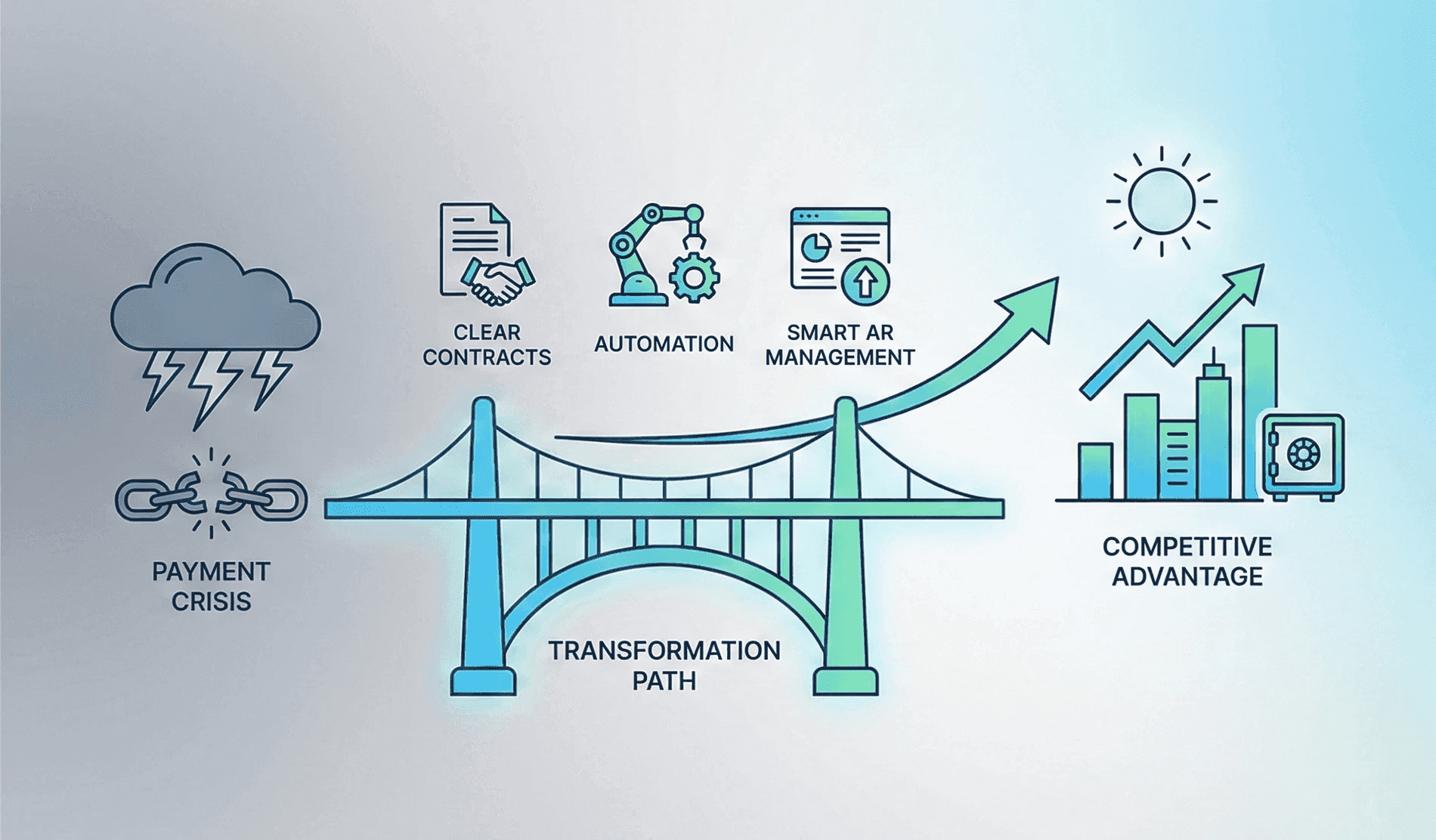
The payment crisis in construction didn’t arise overnight, and solving it will require a suite of improvements, not just a single fix. Combined strategies, clear contracts, rigorous documentation, efficient approvals, and automation, transform AR from a liability into a competitive advantage.
If general contractors prioritize getting payments out quickly, they become more attractive to top subcontractors; those subcontractors price more competitively and deliver better performance. For subcontractors, disciplined invoicing and documentation give them greater control over their cash flow. For project owners and developers, predictable payment practices reduce delays, encourage reliable contractors, and improve overall project delivery outcomes.
In an industry where working capital often determines survival, smart AR management isn’t optional, it’s essential.