The Subscription Economy’s Impact on Accounts Receivable: How Recurring Revenue Changes the AR Playbook
The subscription economy transforms accounts receivable from one-off invoicing to continuous billing and revenue protection.

Pratheek Adi
Co-Founder & CTO

Table of contents
Share
Businesses that rely on recurring revenue, software-as-a-service, membership programs, clubs, recurring professional services, and others, are part of what’s now called the subscription economy. This model has reshaped how companies generate income and how finance teams handle the lifecycle of billing and collections.
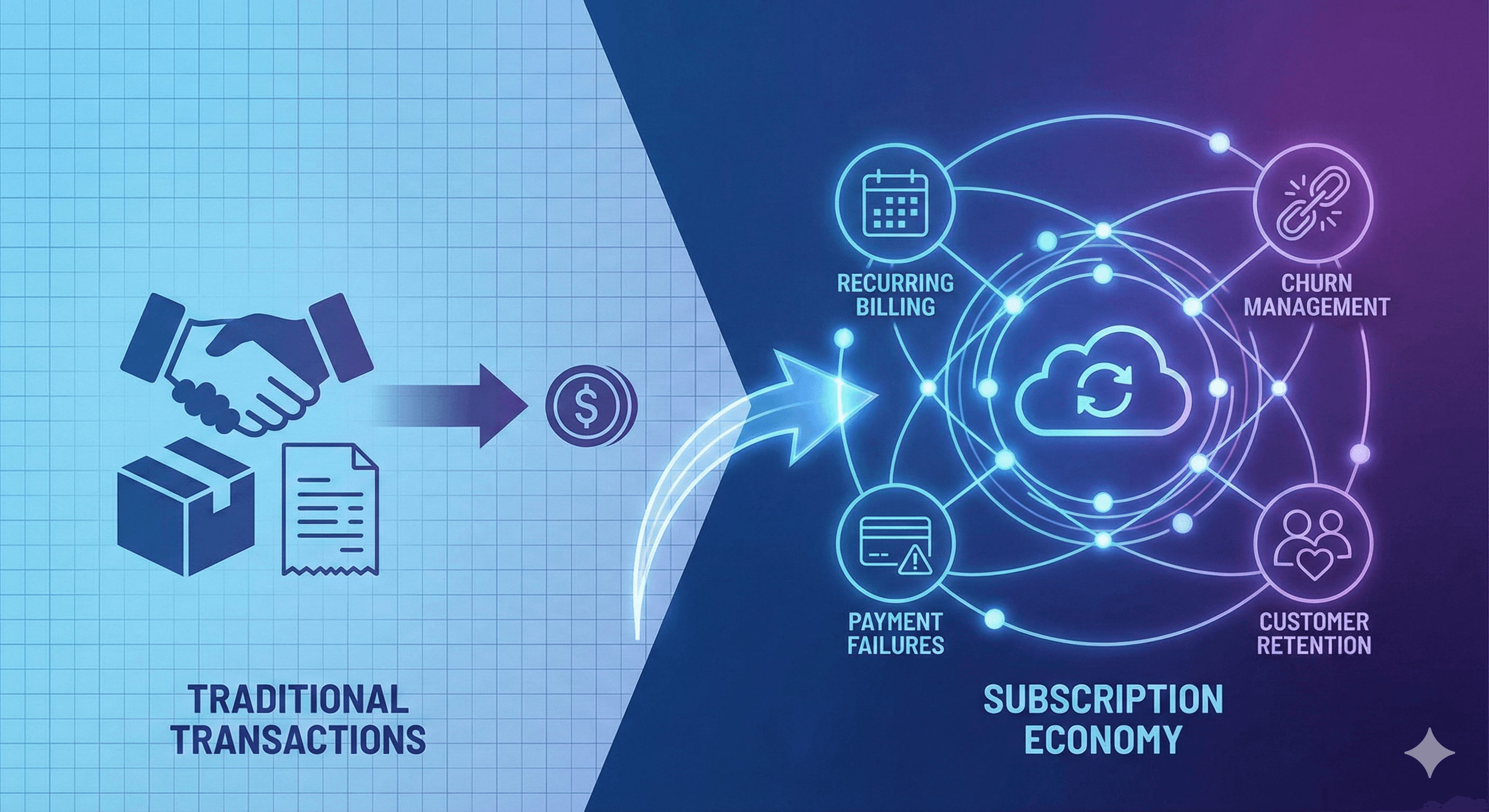
Unlike traditional transactions where a product or service is delivered once and paid once, subscription businesses invoice the same customer repeatedly. That ongoing relationship creates new demands for accounts receivable (AR) teams, from managing recurring billing and complex cancellations to retaining customers amid payment failures and churn.
In this article, you’ll learn how the rise of the subscription economy changes AR practices, why traditional invoicing isn’t enough, and what systems and strategies help finance teams succeed in this environment.
Recurring Revenue Demands a Different AR Approach
In a traditional AR workflow, you send a one-time invoice, track it, follow up if necessary, and move on. In the subscription economy, your business never moves on from a customer until they cancel.
Recurring billing introduces new operational complexity:
You must issue invoices automatically at regular intervals without manual effort.
You need systems that handle upgrades, downgrades, renewals, and prorations without errors.
You must reconcile numerous periodic payments with your general ledger.
You must manage revenue recognition in compliance with reporting standards like ASC 606 / IFRS 15.
For AR teams, this means ongoing workload rather than discrete billing events. Without automated tools to create invoices and reconcile them, subscription AR becomes labor-intensive and error-prone.
Payment Failures Are a Major Source of Revenue Churn
In the subscription model, failed payments are one of the biggest hidden drains on revenue. Payments fail for many reasons, expired cards, insufficient funds, bank declines, or outdated billing information, and when they go unresolved, they directly reduce cash flow.
In fact, research shows that:
Failed payments could cost subscription companies over $129 billion globally by 2025 due to lost recurring revenue alone.
Subscription businesses often see revenue leakage because of failed payments and billing errors, contributing to churn and operational drag.
When a recurring payment fails and isn’t promptly recovered, the customer often becomes a churned customer, even if they intended to stay subscribed. This phenomenon, called involuntary churn, can represent a large share of total churn in subscription businesses, because customers rarely take the time to resolve a failed payment without prompting.
These dynamics make subscription AR fundamentally different: you’re not simply chasing a late invoice, you’re protecting recurring revenue streams and customer relationships.
Dunning Management: A Subscription AR Essential
In the subscription economy, dunning isn’t a buzzword, it’s a core operational requirement. Dunning refers to the systematic process of retrying failed payments and reminding customers to update billing information or settle overdue balances.
Good dunning strategies combine scheduled retries, tailored communication, and escalation rules that keep the customer informed without harming the relationship. Automated systems apply logic such as:
Smart retry schedules that attempt card charges at optimal intervals.
Customized email and SMS reminders with clear calls to action.
Escalation thresholds for when human intervention is needed.
Effective dunning does more than recover payments. It preserves customer goodwill by handling payment issues in a transparent, customer-appropriate way, rather than simply canceling subscriptions and risking churn. Automated dunning can recover significant percentages of failed payment revenue that would otherwise be lost.
Subscription AR Needs Tools Beyond Traditional Invoicing
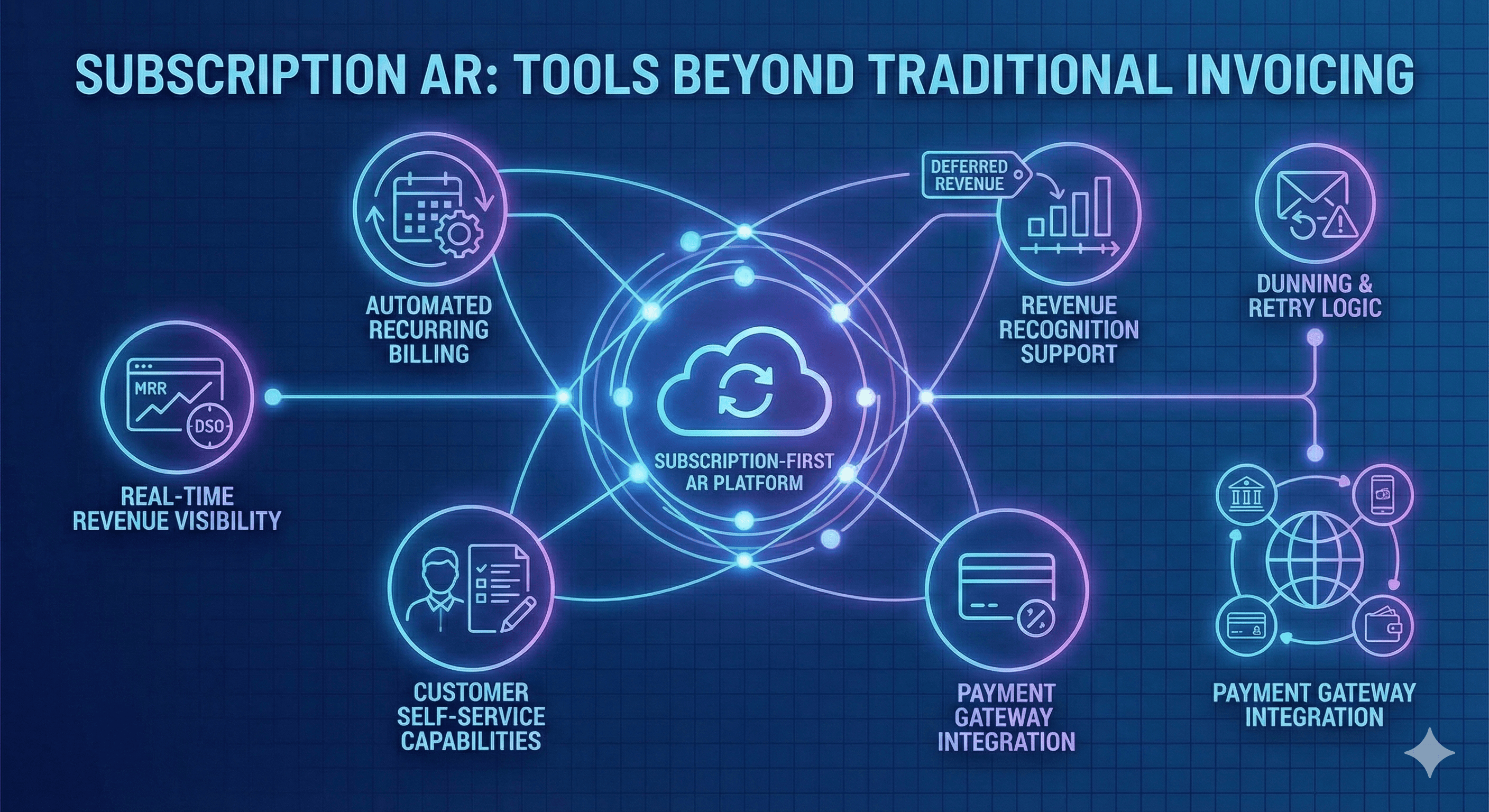
Traditional AR tools were designed for one-off billing cycles. Subscription AR needs features that go well beyond this basic function.
Here’s what subscription-first AR practices require:
Automated Recurring Billing
Software should generate invoices and process charges automatically on predefined schedules, with support for upgrades, downgrades, prorations, and renewals.
Revenue Recognition Support
Subscription revenue often spans periods where the service is delivered. AR systems must support revenue recognition rules that track deferred revenue and comply with reporting standards.
Dunning and Retry Logic
AR teams should automate payment retries and follow-up reminders, using configurable workflows to address common failure reasons and minimize revenue leakage.
Payment Gateway Integration
AR platforms must integrate with multiple payment gateways and methods to maximize payment success rates and offer flexibility to customers.
Customer Self-Service Capabilities
Allowing subscribers to update payment methods, view billing histories, and manage their subscriptions reduces friction and improves collections.
Real-Time Revenue Visibility
Dashboards showing metrics like Monthly Recurring Revenue (MRR), churn rates, and days sales outstanding (DSO) help finance teams monitor health and forecast effectively.
The Connection Between AR Practices and Customer Churn
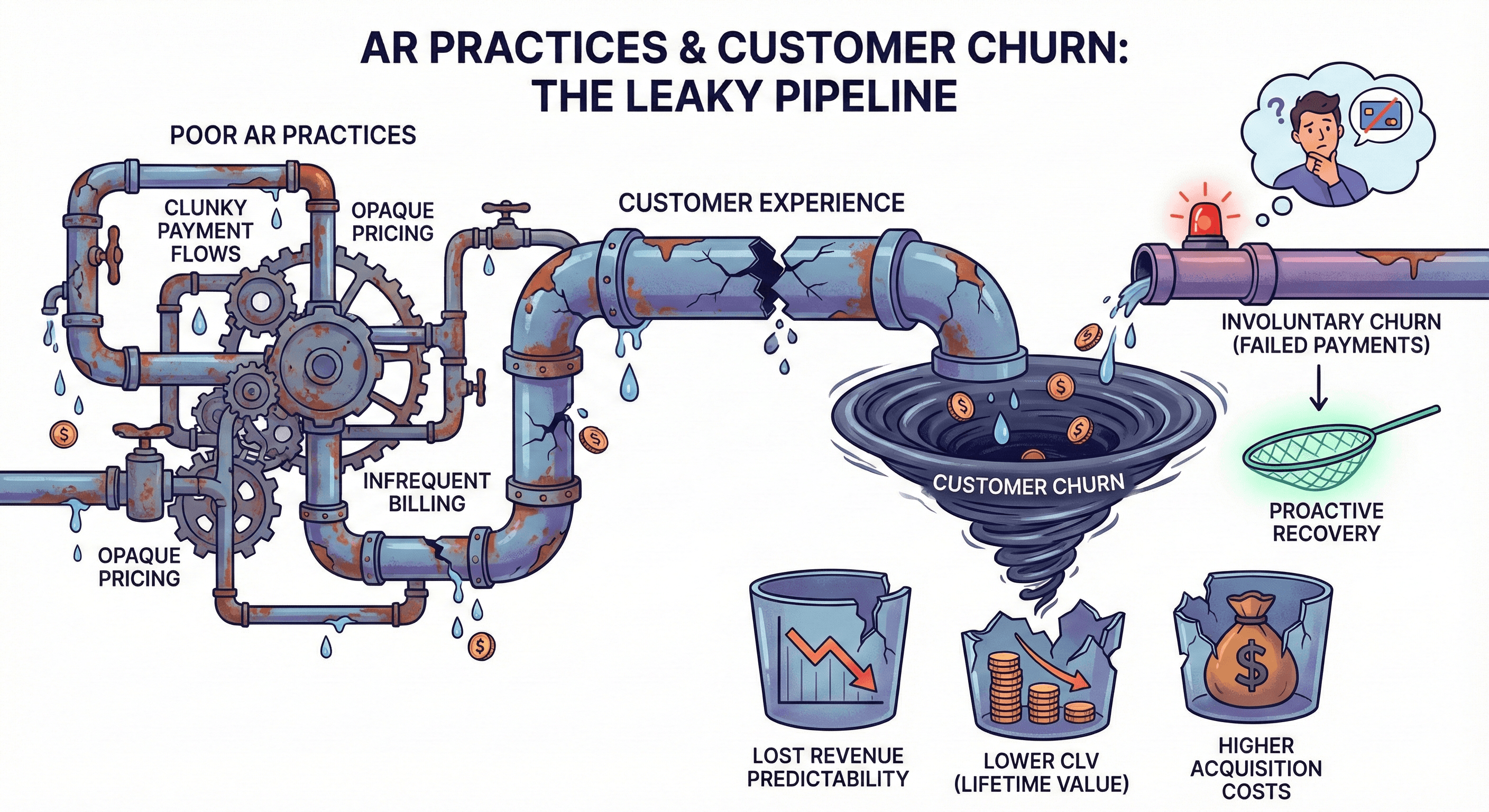
The subscription business model places AR squarely at the intersection of finance and customer experience. Poor billing frequency, opaque pricing, or clunky payment flows don’t just delay cash, they increase churn.
Customer churn has a direct impact on revenue predictability, customer lifetime value (CLV), and acquisition cost because retaining customers is typically cheaper than replacing them.
Involuntary churn due to failed payments is especially insidious because subscribers may not cancel intentionally. They might simply stop being billed because their payment method failed and wasn’t resolved. These customers are often ideal candidates for recovery, but only if the AR processes are designed to catch and correct these issues.
Practical Steps to Adapt AR for Subscription Models
Here’s how finance and AR leaders can align their processes with the subscription economy:
Standardize Recurring Billing Workflows
Map out your recurring billing cycles and automate invoice generation and payment processing so renewals happen without manual steps.
Invest in Automated Dunning Tools
Configure retries and reminders that match your business model, and add escalation paths for exceptions. Track which messages and retry timings yield the best recoveries.
Segment Customer Accounts by Risk
Use data to classify customers by payment history, churn likelihood, and revenue potential. Prioritize communication for at-risk accounts before they churn.
Offer Flexible Payment Methods
Support a range of payment options (credit cards, ACH, digital wallets) and ensure your AR system can handle them seamlessly.
Enable Self-Service Billing Management
Let customers update payment methods and view their billing details online. This reduces friction and empowers them to resolve issues on their own.
Integrate AR With Billing and CRM Systems
Synchronization between AR platforms, billing systems, and CRMs ensures consistency, reduces errors, and improves the timeliness of actions across departments.
Why AR Automation Is Critical in the Subscription Economy

Manual AR processes cannot scale to handle billing complexities, frequent renewals, and churn mitigation efforts over time. Subscription AR is continuous, and stagnation in collections workflows directly hurts cash flow and growth.
A platform tailored to subscription billing and collections can help by:
Automating recurring invoices and payment processing.
Managing smart retries and dunning workflows.
Helping finance teams spot trends in churn and payment failures.
Offering self-service portals that reduce customer friction.
Abivo integrate with your billing and accounting systems while offering automation and AI-powered outreach. Abivo helps ensure payments happen on schedule and provides consistent follow-up for issues before they escalate, something standard AR tools aren’t built to handle.
In the subscription economy, AR isn’t a back-office afterthought. It’s a proactive part of customer lifecycle management and revenue operations. The businesses that align their AR practices with subscription realities are the ones that maintain predictable cash flow and strong customer retention.
Practical Takeaways
Recurring revenue changes AR from occasional invoicing to continuous billing, follow-up, and cash flow management.
Failed payments aren’t just accounting errors, they drive revenue leakage and involuntary churn in subscription businesses.
Automated dunning and retry logic recover revenue that manual processes often miss.
AR systems for subscription businesses need billing automation, integration, and customer-centric tools beyond standard invoicing.
Align AR with customer experience by offering flexible payment methods and self-service billing portals.