Top 5 Accounts Receivable Trends to Watch in 2026
In 2026, accounts receivable is more than chasing invoices, AI, predictive analytics, faster payments, and automation are reshaping AR into a strategic driver of cash flow and customer experience.

Pratheek Adi
Co-Founder & CTO

Table of contents
Share
Accounts receivable is no longer a back‑office function quietly chasing invoices. As economic pressure, customer expectations, and technology all evolve at once, AR is becoming a strategic lever for cash flow, customer experience, and business resilience. For service‑based SMBs and fast‑growing startups that issue hundreds or thousands of invoices per month, how receivables are managed in 2026 will look very different from just a few years ago.
Finance leaders are being asked to do more with less: protect cash flow, reduce manual work, and preserve customer relationships at the same time. The following five trends are shaping how AR teams operate and where investment is shifting as we move into 2026.
1. AI‑Driven Collections Become the Default
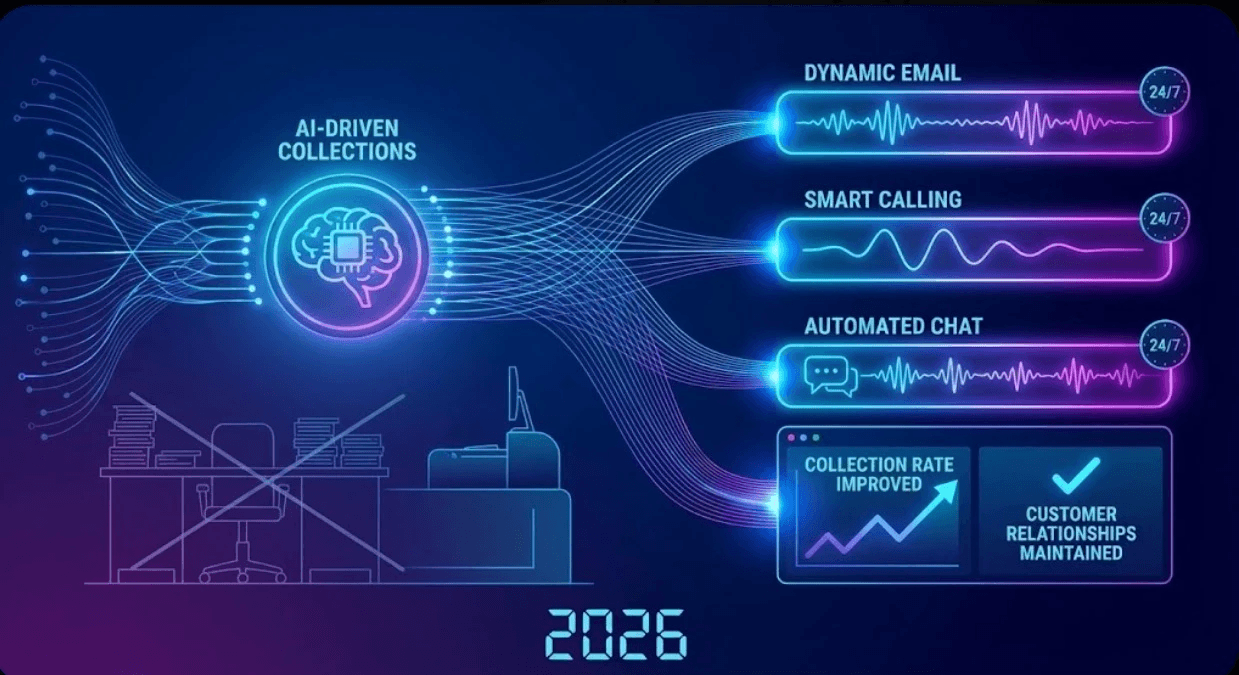
Artificial intelligence is rapidly moving from experimental to essential in accounts receivable. In 2026, AI‑driven collections are expected to be a standard part of modern AR operations rather than a nice‑to‑have feature.
AI systems can analyze large volumes of historical payment data to identify patterns humans would struggle to spot. These tools determine when customers are most likely to pay, which communication channels work best, and how messaging should be adjusted based on past behavior. According to McKinsey, AI‑enabled finance functions can improve productivity and reduce operational costs significantly by automating repetitive tasks and enhancing decision‑making.
For AR teams, this means less time manually following up and more time focusing on exceptions and high‑risk accounts. AI calling and email agents can run collections workflows around the clock, ensuring no invoice is forgotten while maintaining consistent, professional communication.
The biggest shift in 2026 is not just automation, but intelligence. Instead of sending the same reminder to every customer, AI adjusts timing, tone, and escalation paths dynamically. This improves collection rates without damaging customer relationships.
2. Predictive Analytics Shapes Cash Flow Decisions
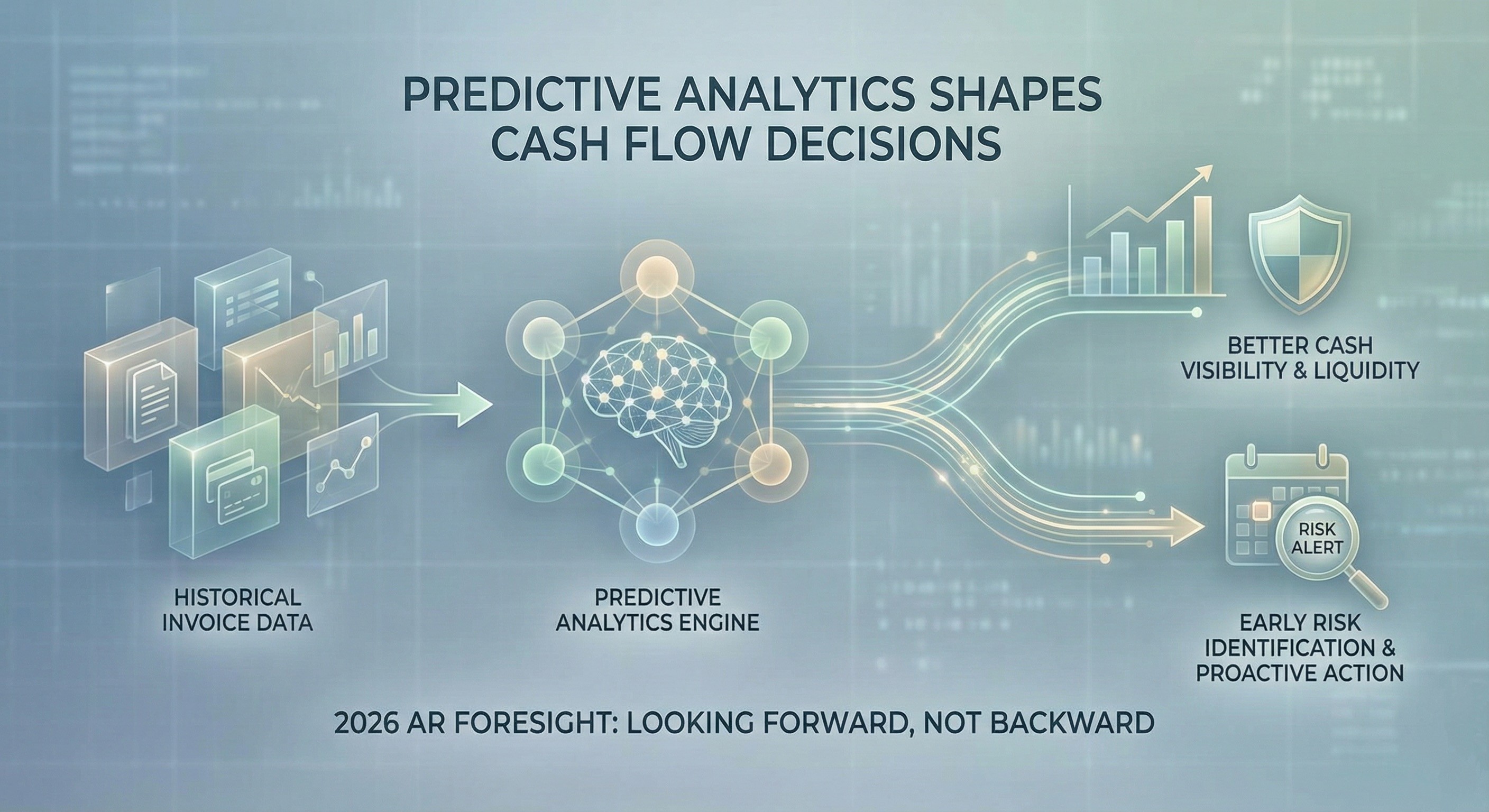
Looking backward is no longer enough. In 2026, AR teams are increasingly expected to forecast what will happen next.
Predictive analytics uses historical invoice, payment, and customer data to estimate future cash inflows and identify risk early. Rather than reacting to overdue invoices, finance teams can see which customers are likely to pay late weeks in advance and take preventive action.
Gartner has noted that predictive and prescriptive analytics are becoming core capabilities for finance teams as organizations seek better visibility into working capital and liquidity.
In practice, predictive AR analytics can help businesses:
Forecast days sales outstanding (DSO) more accurately
Identify customers at risk of delinquency
Adjust credit terms proactively
Plan cash needs with greater confidence
For service‑based businesses operating on thin margins, this level of foresight can be the difference between stability and constant cash flow stress.
3. Real‑Time and Faster Payments Gain Momentum
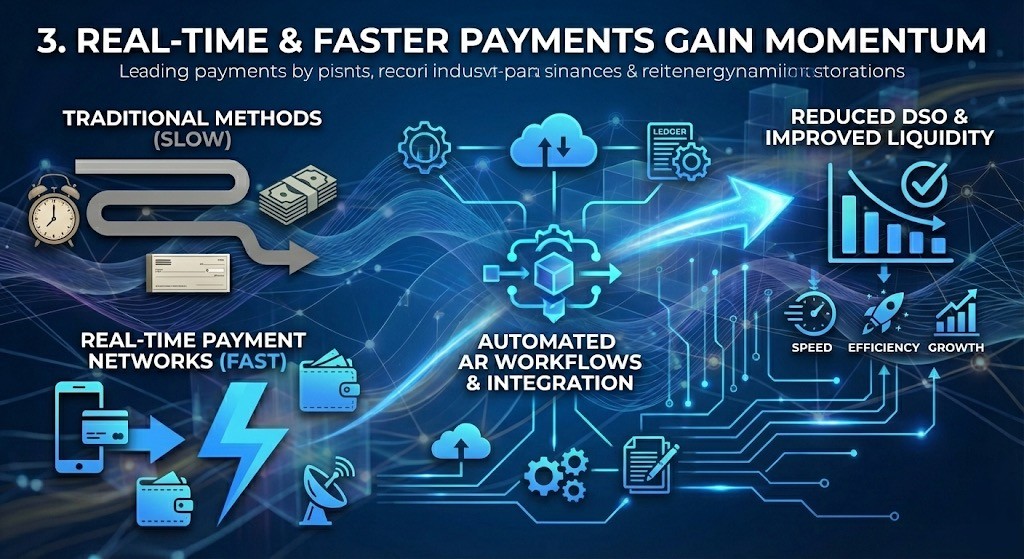
Traditional B2B payments are slow. Checks, ACH transfers, and even some card payments can take days to settle. In 2026, pressure continues to build for faster, near‑real‑time payment options.
Real‑time payment networks and instant payment rails are expanding globally, driven by customer expectations shaped by consumer experiences. According to the Federal Reserve, adoption of instant payment systems like FedNow reflects growing demand for immediate fund availability in business transactions.
For AR teams, faster payments mean:
Reduced DSO
Improved liquidity
Less reliance on short‑term borrowing
However, speed alone is not enough. Real‑time payments must be tightly integrated with invoicing and reconciliation systems. Without automation, faster money can still create reconciliation headaches.
In 2026, the competitive advantage lies in combining real‑time payment options with automated AR workflows so cash moves quickly and accurately from customer to ledger.
4. Customer Experience Becomes Central to AR Strategy
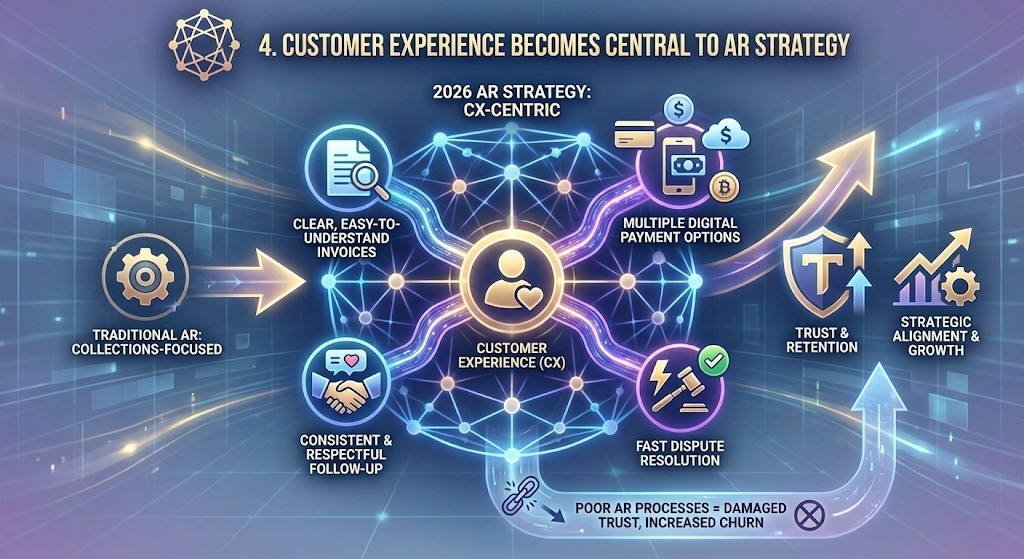
Customer expectations around billing and payments are rising quickly. Businesses now expect the same level of clarity, convenience, and responsiveness from invoicing as they do from sales and support.
Studies from PwC show that customers are willing to switch providers after just a few poor experiences, and billing is increasingly recognized as a key part of that experience.
In 2026, AR teams are being measured not only on collection rates, but also on how smoothly and professionally they interact with customers. This includes:
Clear, easy‑to‑understand invoices
Multiple digital payment options
Consistent and respectful follow‑up
Fast resolution of disputes
Poor AR processes can damage trust, increase churn, and undo the work of sales and customer success teams. As a result, AR is becoming more closely aligned with customer experience strategy rather than operating in isolation.
5. AR Automation Platforms Replace Patchwork Processes
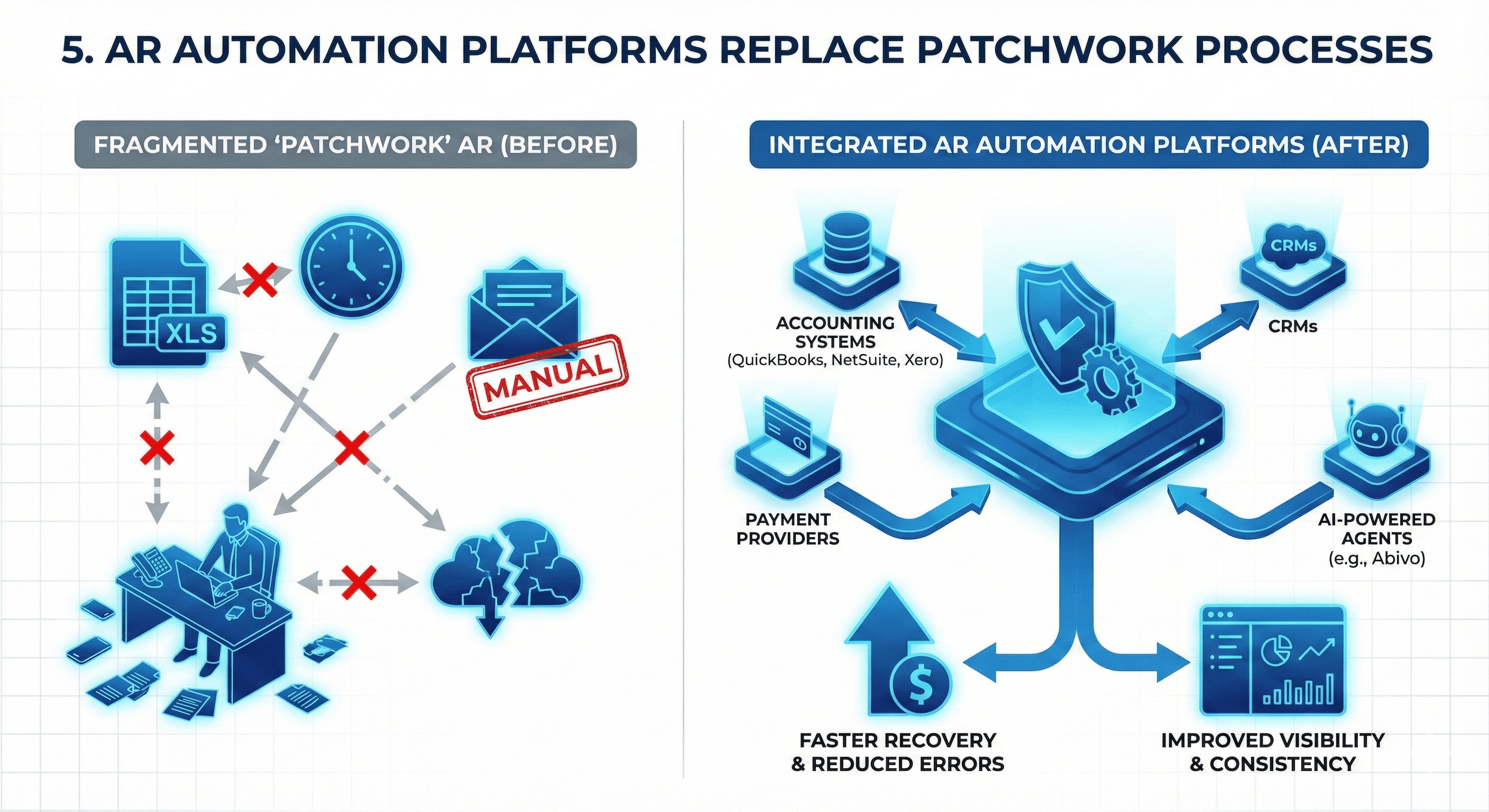
Many SMBs still rely on a mix of accounting software, spreadsheets, manual emails, and ad hoc reminders to manage receivables. In 2026, this fragmented approach is becoming unsustainable.
Finance leaders are consolidating tools and adopting purpose‑built AR automation platforms that integrate directly with accounting systems, CRMs, and payment providers. According to Deloitte, automation and integration are key priorities for finance transformation as teams face growing transaction volumes and complexity.
Modern AR platforms centralize invoicing, reminders, collections activity, and reporting in one place. This reduces errors, improves visibility, and ensures consistent execution across the entire receivables lifecycle.
Solutions like Abivo (abivo.ai) bring AI‑powered calling and email agents into existing accounting workflows, helping service‑based businesses recover revenue faster without adding headcount. By integrating with systems like QuickBooks, NetSuite, Xero, and others, automation becomes a natural extension of current processes rather than a disruptive overhaul.
What These Trends Mean for Service‑Based SMBs
For service‑based businesses that rely heavily on invoicing, these trends are not abstract future concepts. They directly affect cash flow, scalability, and customer retention.
The common thread across all five trends is proactive management. Instead of reacting to overdue invoices, AR teams in 2026 are expected to anticipate issues, automate routine work, and deliver a smoother experience for customers.
Businesses that delay modernizing their AR processes risk falling behind competitors who collect faster, communicate better, and operate with greater financial visibility.
Practical Takeaways
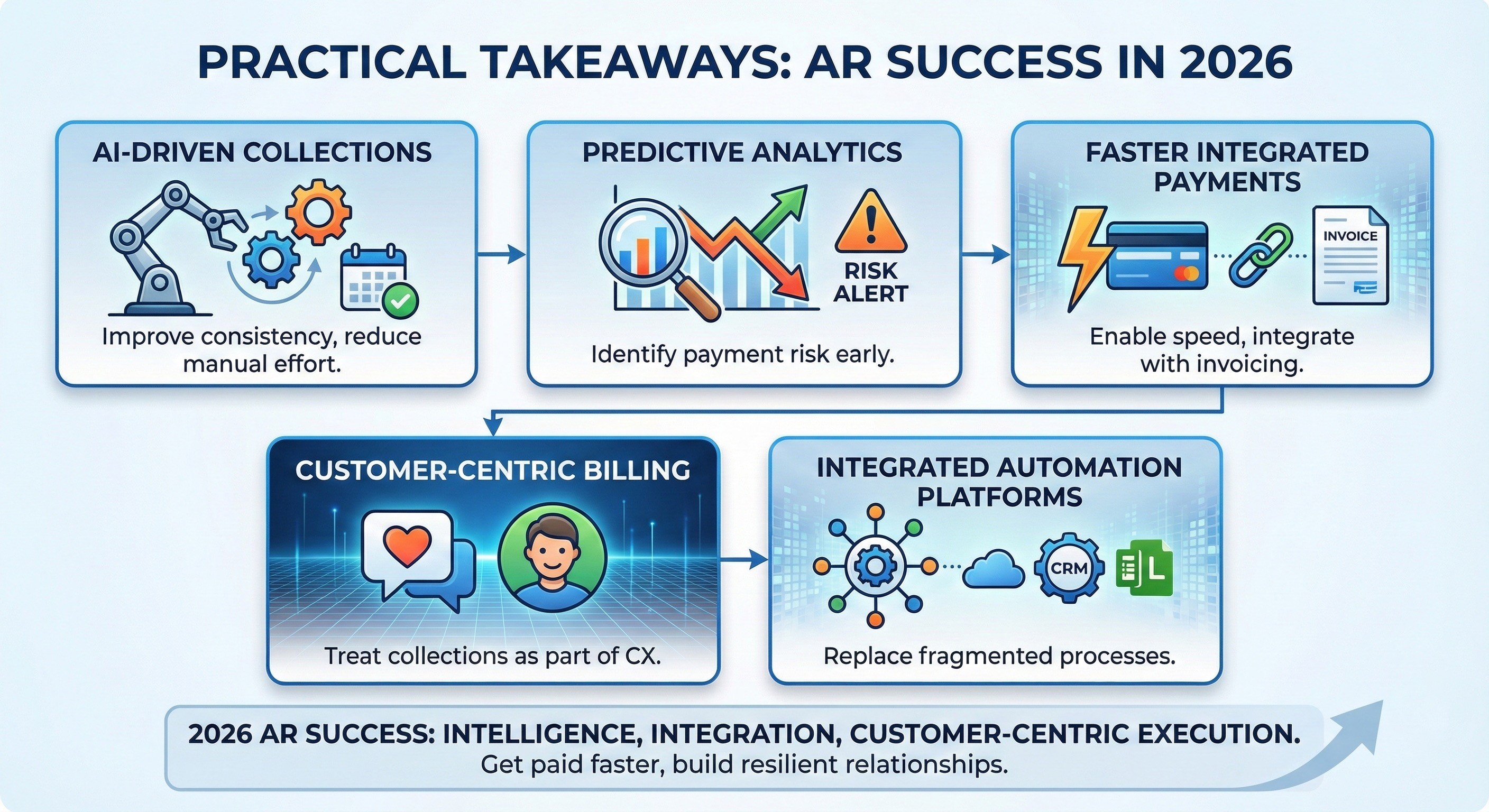
Invest in AI‑driven collections to improve consistency and reduce manual effort.
Use predictive analytics to identify payment risk before invoices become overdue.
Enable faster payment options and integrate them directly into invoicing workflows.
Treat billing and collections as part of the customer experience.
Replace fragmented AR processes with integrated automation platforms.
Accounts receivable is entering a new phase. In 2026, success depends on intelligence, integration, and customer‑centric execution. Businesses that embrace these trends will not only get paid faster, they will build stronger, more resilient relationships with their customers in an increasingly competitive environment.