When to Hire a Collections Specialist (and When to Automate Instead)
The Ultimate Guide to Scaling Accounts Receivable: When to Hire a Specialist vs. Automating with AI (2025 Edition)

Soham Gawde
Business Analyst

Table of contents
Share
The Cash Flow Paradox in the Modern Economy
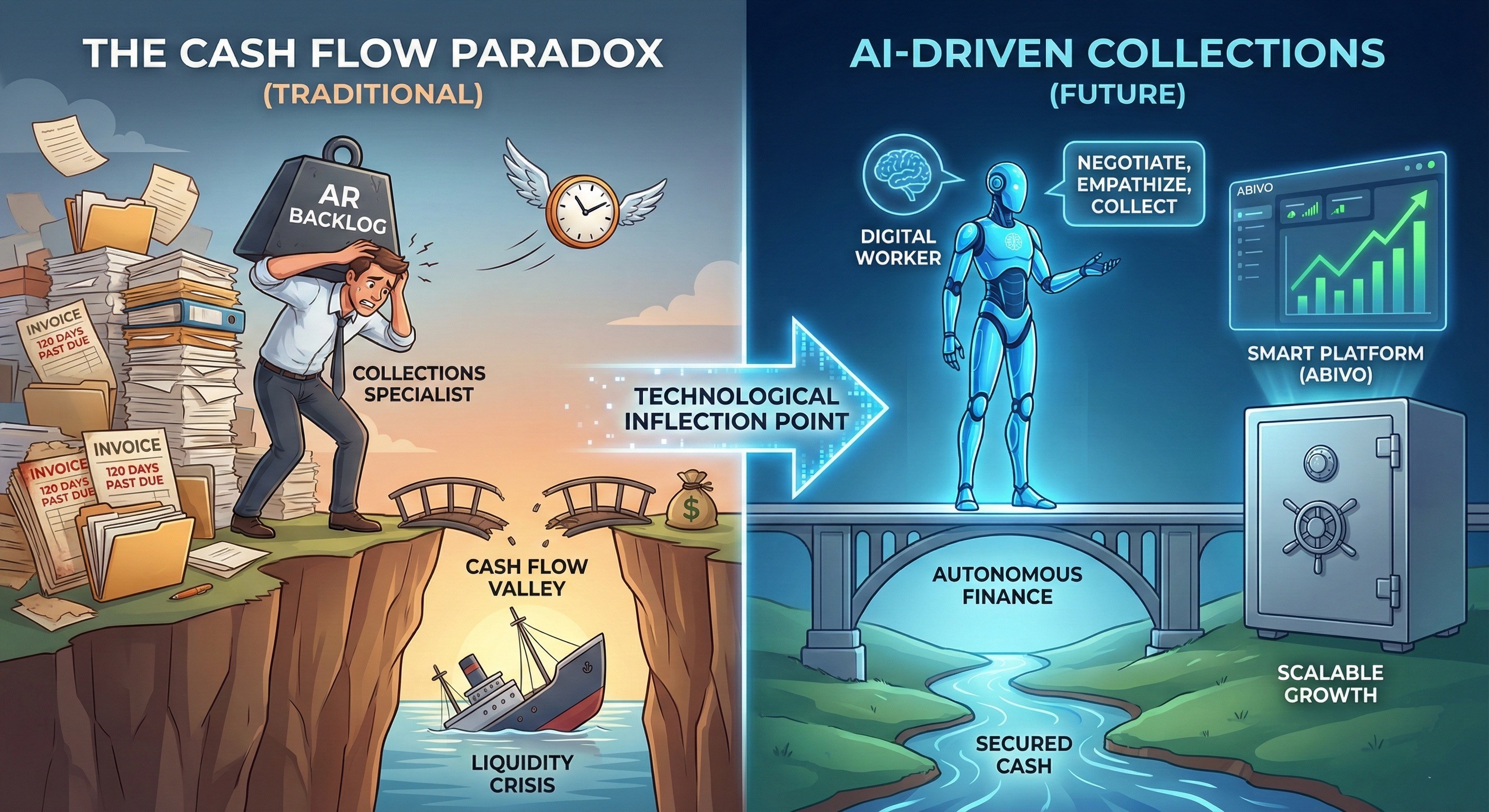
In the high-stakes environment of 2025, cash flow has evolved from a simple financial metric into the primary determinant of business survival. For Small and Medium-sized Businesses (SMBs), particularly those in service sectors like construction, healthcare, and professional services, the gap between service delivery and payment receipt, the “cash flow valley”, has widened dangerously. The economic landscape, characterized by fluctuating interest rates and persistent inflationary pressures on operational costs, means that the cost of capital is no longer negligible. Every day an invoice sits unpaid, the business is effectively financing its customer at a premium, eroding profit margins that are already under siege.
The challenge is not typically a lack of sales or revenue generation. Service-based businesses are often booking record numbers of jobs. The paradox lies in the liquidity crisis generated by delayed payments. The “silent killer” of these businesses is the accumulation of Accounts Receivable (AR) that ages beyond the standard Net 30 terms, drifting into the perilous territories of 60, 90, and 120 days past due. As these balances grow, they create a suffocating weight on the organization, limiting the ability to invest in growth, hire talent, or even cover basic operational expenses like payroll and inventory procurement.
Traditionally, the solution to a growing AR backlog was linear and human-centric: hire a Collections Specialist. The logic was straightforward. If you have more phone calls to make, you need more people to make them. However, as we navigate the mid-2020s, this traditional wisdom is colliding with harsh new realities. The labor market has shifted, the cost of human capital has skyrocketed, and the efficiency ceiling of manual labor has become a bottleneck that no amount of hiring can fully resolve.
Simultaneously, we are witnessing a technological inflection point. Artificial Intelligence (AI) has matured from experimental chatbots into robust, autonomous agents capable of complex human-like interactions. Platforms like Abivo are at the forefront of this revolution, offering “digital workers” that can negotiate, empathize, and collect revenue with a speed and consistency that human teams cannot match.
This report serves as an exhaustive strategic roadmap for finance leaders and business owners facing this critical crossroads. We will dissect the economics of manual collections versus automation, explore the psychological and operational nuances of each approach, and provide industry-specific playbooks for trades, healthcare, and professional services. The goal is to empower you to choose the path that not only recovers revenue but builds a resilient, scalable financial foundation for the future.
The Economics of Manual Collections
To make a truly informed decision, one must first conduct a forensic accounting of the status quo. Hiring a collections specialist is often viewed through the simplified lens of a base salary. However, the true economic impact of adding headcount to the finance department is a complex equation involving hidden costs, efficiency limits, and significant operational risks.
The Rising Cost of Human Capital
The direct financial cost of employing a collections specialist in North America has seen a marked increase, driven by inflation and the rising demand for skilled financial labor. As of late 2024 and moving into 2025, the base salary for a mid-level Collections Specialist generally falls between $41,000 and $55,000 annually.1 However, averages can be deceptive. In high-cost operational hubs such as San Francisco, New York, or Boston, these salaries frequently exceed $60,000 to $65,000.
This base salary, however, is merely the tip of the financial iceberg. To understand the “Total Cost of Ownership” (TCO) for a human employee, businesses must calculate the “fully burdened” cost. This includes mandatory payroll taxes, health insurance, retirement contributions (401k matching), workers’ compensation, and paid time off. Standard HR benchmarks suggest that these burden costs add approximately 25% to 40% to the base salary.
Additionally, there are infrastructure costs. A collections specialist requires a computer, software licenses (ERP seats, CRM access), a phone line, and office space (or remote work stipends). When these are factored in, a specialist with a nominal salary of $50,000 effectively costs the business between $71,500 and $81,000 per year.
The Fully Burdened Cost of a Collections Specialist (Annual Estimates)
Cost Category | Estimated Annual Cost | Description |
Base Salary | $50,000 | Mid-level experience based on national averages. |
Benefits & Taxes | $15,000 | Health, dental, vision, FICA, 401k (approx. 30%). |
Overhead & Infrastructure | $8,000 | Office space, hardware, software licenses, phone systems. |
Training & Recruitment | $4,000 | Amortized cost of hiring fees, job postings, and management time. |
Total Annual Cost | $77,000 | The actual revenue requirement to break even on the hire. |
This table illustrates a critical reality (businesses must collect significantly more than $77,000 in additional recovered revenue just to break even on this hire). If the specialist is merely maintaining the status quo, they are a cost center, not a value driver.
The Turnover and Retention Crisis

Perhaps the most debilitating hidden cost in manual collections is turnover. The role of a collections specialist is inherently high-stress. Agents are tasked with making dozens of adversarial calls daily, facing rejection, hostility, and emotional fatigue. They are the bearers of bad news, constantly asking for money from customers who may be struggling or unhappy.
Consequently, the turnover rate for call center and collections staff is among the highest of any profession, hovering between 30% and 45% annually. In 2024, contact center turnover rates reached 31.2%, meaning nearly one in three agents leaves their position every year.
This high churn rate creates a “revolving door” effect that devastates operational continuity.
The Knowledge Drain: When a tenured collector leaves, they take with them the nuanced institutional knowledge of the client base. They know which customers need a gentle nudge and which need a firm hand; they know the specific billing cycles of key accounts. This tacit knowledge is lost, resetting the department’s effectiveness.
The Recruitment Cycle: Replacing an agent is expensive and time-consuming. The average cost to replace an agent is estimated at $15,000, factoring in recruitment fees, interviewing time, and lost productivity.
The Ramp Time: Once a new hire is in place, they do not become fully productive immediately. The “ramp time”, the period required to learn the company’s ERP systems, product lines, and tone of voice, averages 3 to 6 months. During this period, the business pays for full productivity but receives only a fraction of it, leading to a backlog of unworked accounts.
The Biological Efficiency Ceiling
Beyond cost, human capacity has biological and logistical limits. A diligent human agent can make, at maximum, 80 to 100 outbound dials per day. However, in the modern era of spam filtering and caller ID screening, connection rates are historically low. Only 20% to 30% of these calls typically result in a live conversation (Right Party Contact).
This creates a severe bottleneck. If a business generates 1,000 invoices a month, and 20% of them go past due, that is 200 accounts to manage. If each account requires 3-5 follow-up attempts, a single human collector is quickly overwhelmed. They are forced to prioritize, usually focusing on the largest balances or the oldest debts, leaving the “long tail” of smaller, newer invoices to age until they become critical problems.
This “triage” approach is a symptom of the efficiency ceiling. It leaves money on the table simply because the cost of human labor makes it uneconomical to chase smaller debts manually. A human agent costing the company $35/hour cannot profitably spend an hour chasing a $50 invoice. That revenue is effectively abandoned, written off as the cost of doing business.
The Psychological Toll and “Nice Guy” Syndrome
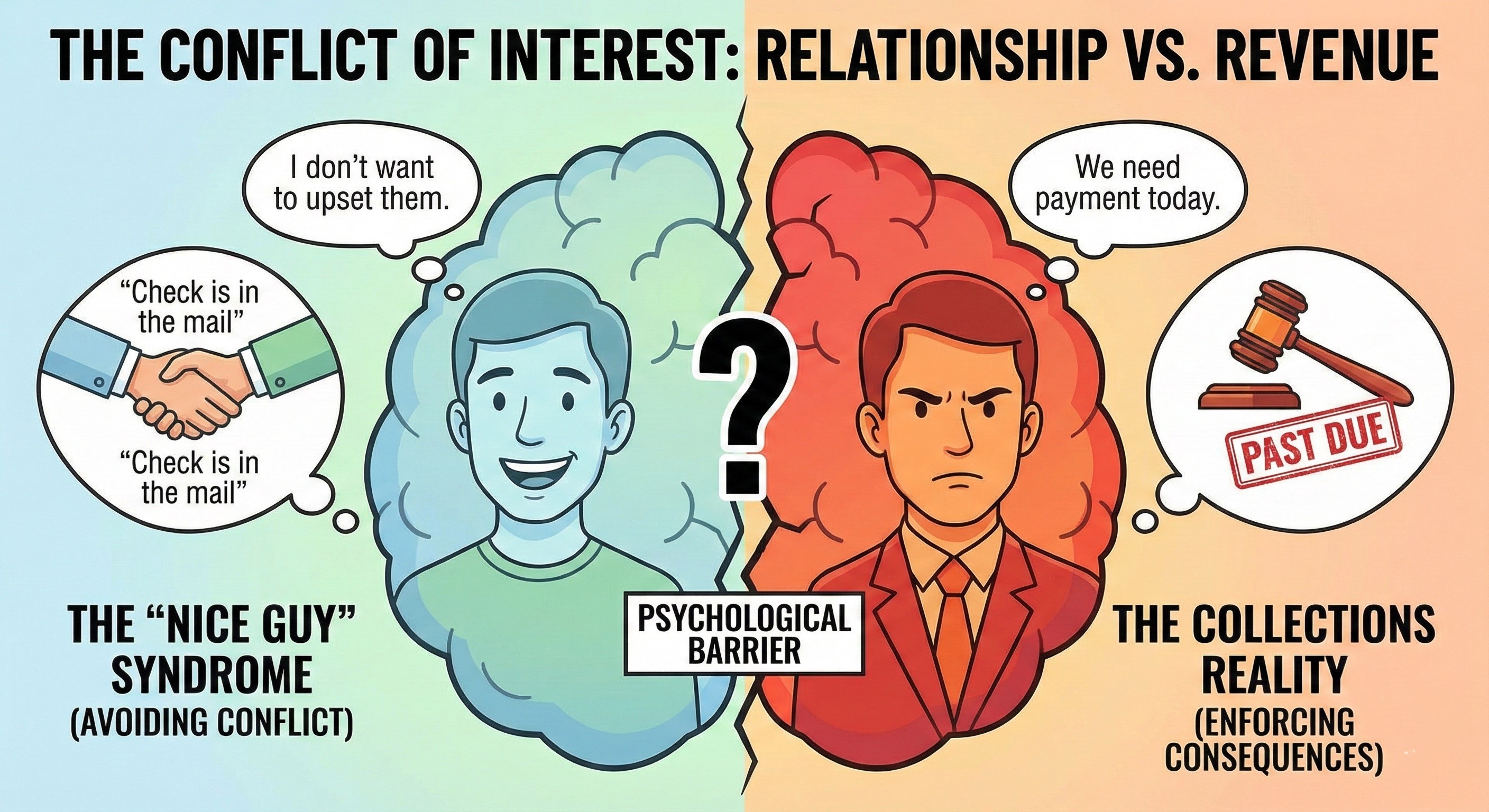
Another subtle but significant limitation of manual collections is the psychological barrier. In many SMBs, the person tasked with collections is often the same person responsible for sales or customer service. This creates a conflict of interest. An account manager who wants to upsell a client next month may be hesitant to be firm about a past-due invoice today.
Even dedicated collections staff can suffer from “Nice Guy” syndrome, where they accept vague promises (“The check is in the mail,” “I’ll pay next week”) without enforcing consequences, simply to avoid conflict. This leniency extends payment cycles and increases DSO. Humans are social creatures wired to avoid confrontation; collections requires a level of persistence that can be emotionally draining to maintain day after day.
The Automation Revolution and the Rise of AI Agents
In stark contrast to the linear limitations of human labor, AI automation offers exponential scalability and consistency. However, it is crucial to distinguish between the “legacy automation” of the past decade and the “AI Agents” of 2025.
From Static Workflows to Cognitive Agents
Legacy automation refers to static, rules-based workflows. For example (If Invoice #123 is 5 days overdue, send Email Template A). While this was an improvement over manual typing, it lacked nuance. It could not negotiate, it could not answer questions, and it often alienated customers by sending generic, robotic demands to valued clients who may have simply missed an email due to travel or illness.
The new paradigm, exemplified by platforms like Abivo, utilizes AI Agents. These are intelligent systems built on Large Language Models (LLMs) and advanced voice synthesis technologies. They possess cognitive capabilities that mimic human interaction:
Multi-Channel Engagement: AI agents operate fluidly across email, SMS, and voice. They meet the customer where they are, using the channel the customer prefers.
Contextual Understanding: Using Natural Language Processing (NLP), an AI agent can read a customer’s email reply (“I can’t pay yet because I’m waiting on a PO number”) and respond contextually (“I understand. I have attached the PO request form to this email. Once you have the number, please reply here”). This is a fundamental shift from “blind” automation.
Generative Voice Interaction: Perhaps the most significant advancement is in voice AI. These agents can conduct outbound phone calls with a voice that sounds indistinguishable from a human. They can navigate phone trees, leave intelligent voicemails, handle interruptions, and negotiate payment plans within pre-set parameters.
The Economics of AI Automation
The Return on Investment (ROI) for AI automation is fundamentally different from the hiring model. Instead of a large step-function cost (adding a $70k salary), automation typically involves a software subscription that scales with volume.
Research indicates that the cost per invoice for automated processing is approximately $1 to $5, compared to $12 to $30 for manual processing.10 This represents a cost reduction of 60% to 80%.10 For a business processing 500 invoices a month, the manual labor cost could exceed $72,000 annually, whereas automation might cost between $5,000 and $15,000 depending on the complexity and volume.
Cost Comparison per Transaction
Metric | Manual Processing | AI Automation | Cost Reduction |
Cost Per Invoice | $12.00 - $30.00 | $1.00 - $5.00 | ~80% 10 |
Processing Time | 15-30 minutes | Seconds | ~99% |
Availability | 40 hours/week | 168 hours/week | 4.2x capacity |
Error Rate | 1-3% | 0.1% | Significant reduction 10 |
Breaking the Efficiency Ceiling
Automation shatters the biological limits of human collectors. An AI agent does not have a limit on calls per day. It can contact 5,000 customers in a single hour if necessary, allowing for massive scalability during peak seasons.
Furthermore, AI agents work 24/7/365. This is particularly valuable for businesses with national or international clients in different time zones. It also allows the business to engage with residential customers (in trades or medical fields) during evening hours when they are more likely to answer the phone and discuss personal finances, something a 9-to-5 employee cannot easily do.
The AI agent never gets tired, never has a “bad day,” never gets frustrated with a rude customer, and never deviates from the compliant script. This consistency ensures that every customer receives the same high standard of professional communication, protecting the brand’s reputation even during collections activity.
ROI Benchmarks: What to Expect
The financial impact of this efficiency is measurable and significant. Businesses implementing comprehensive AR automation typically see:
DSO Reduction: A decrease in Days Sales Outstanding by 10% to 20% within the first 6 to 12 months. For a business with $5 million in annual revenue, reducing DSO by just 5 days releases nearly $70,000 in working capital back into the business immediately.
Bad Debt Reduction: A lower percentage of invoices written off as uncollectible, often improving by 15% to 25%. By engaging customers earlier and more consistently, AI prevents debts from aging into the “uncollectible” zone (typically 90+ days).
Staff Productivity: A 2x to 3x increase in the revenue managed per Full-Time Employee (FTE). This allows the existing finance team to handle business growth without needing to hire additional headcount.
Critical Thresholds (When to Switch?)
While the economic case for automation is compelling, it is not the correct solution for every single business or every single invoice. The decision matrix depends heavily on Volume, Complexity, and Customer Value.
The 500-Invoice Threshold
The most reliable indicator that it is time to automate is volume. When a business generates more than 500 invoices per month, manual collections become mathematically impossible without a large, expensive team.
At 500 invoices a month, assuming a standard 20 day working month, a single collector would need to process 25 new invoices every single day, in addition to following up on the backlog of past-due accounts from previous months.14 This volume forces the “triage” behavior mentioned earlier. Automation is the only way to ensure that every invoice receives a consistent follow-up cadence.
The “Long Tail” of Small Balances
In industries like medical clinics, subscription services, or residential trades, a business might have thousands of customers owing small amounts (e.g., $20 to $100). Chasing these debts manually is a negative ROI activity.
Scenario: A patient owes a $40 copay.
Manual: A collector earning $25/hour spends 15 minutes reviewing the account, calling, leaving a voicemail, and documenting the attempt. Cost: ~$6.25. If they have to call 3 times to get a payment, the cost rises to ~$18.75. The business has spent nearly 50% of the revenue just to collect it.
Automation: An AI agent sends an SMS and makes a voice call. Cost: ~$0.50. The business retains almost the entire value of the invoice.
AI agents allow businesses to “mine the long tail” of small debts that were previously written off as “too expensive to collect.”
The “White Glove” Exception
There is a specific scenario where hiring is still the superior strategy (the High-Value/High-Complexity Account).
If a business operates on a “whale” model, where 80% of revenue comes from 20% of clients, automation should be used sparingly. If a key account worth $1 million a year is late on a payment, it is likely due to a complex internal issue (e.g., a merger, a change in AP software, or a lost invoice). Sending a robotic reminder to the CFO of a key client can be perceived as insulting and damage the relationship.
In these cases, a human specialist (or the business owner) should handle the interaction. White-glove service requires white-glove collections. However, even here, AI can play a supporting role by providing the human with data: “Alert: Key Account X is 5 days late, which is unusual based on their payment history.”
Industry Deep Dive

The dynamics of collections vary wildly across industries. The right choice depends on the specific “payment culture” and workflow of your sector.
Sector 1: Trades & Home Services (HVAC, Plumbing, Construction)
The Landscape:
This sector is characterized by high invoice volume, project-based billing, and a mix of residential and commercial clients. The workflow is heavily dependent on Field Service Management (FSM) software like ServiceTitan, Jobber, BuildOps, and Housecall Pro.
The Pain Points:
Field-to-Office Lag: Technicians finish a job, but the office might not generate the invoice for days due to manual data entry delays. This increases DSO before the clock even starts.
The “Truck Roll” Cost: Sending a technician out is expensive (fuel, vehicle wear, labor). Not getting paid for that time is devastating to margins.
Paper Checks: Many residential customers still prefer to pay by check, which is slow and requires manual reconciliation.
The Automation Case:
For a plumbing or HVAC company sending 800 invoices a month, hiring a dedicated AR person is a significant overhead addition. Automation can integrate directly with ServiceTitan or QuickBooks.
Workflow: When a job is marked “Complete” in the FSM software, the invoice is generated and sent instantly via email and SMS.
Abivo Application: An AI voice agent can call a residential customer 3 days after the invoice is sent. “Hi, this is the billing assistant for Miller Plumbing. We finished the installation of your water heater on Tuesday. I see the invoice was sent to your email. Would you like to pay that now over the phone to avoid a mailed bill?” This proactive outreach prevents the invoice from being buried in a junk mail folder.
ROI: Reducing DSO in construction from the industry average of 50+ days to 30 days can free up capital to buy materials for the next job without using a high-interest line of credit.
When to Hire Instead:
Hiring is necessary for commercial construction contracts involving AIA (American Institute of Architects) billing. These applications for payment are complex, legalistic documents that require human assembly, notarization, and lien waiver management. AI is not yet capable of managing this level of documentation complexity.
Sector 2: Medical Clinics & Healthcare
The Landscape:
Healthcare billing is unique due to the bifurcation of payers (Insurance vs. Patient). The “Bad Debt” crisis in healthcare is largely driven by the rise of High Deductible Health Plans (HDHPs), which shift a greater burden of cost directly to the patient (Patient Responsibility).
The Pain Points:
High Volume, Low Balance: A clinic may have thousands of outstanding balances ranging from $20 to $100.
Confusion: Patients often do not pay because they are waiting for the Explanation of Benefits (EOB) from their insurer, or they simply do not understand the bill. “Surprise billing” creates resistance.
Data sensitivity: Patient billing records are sensitive, so practices are careful about which tools and people can see them.
The Automation Case:
Medical practices are prime candidates for AI automation due to the sheer volume of small transactions.
Patient Education: An AI agent can effectively explain the bill. “Hi, this is an automated call from Dr. Smith’s office. We have received the payment from your insurance company. They covered $100 of the procedure, leaving a patient responsibility balance of $45. Would you like to take care of that today?” This clarity removes the friction of confusion.
Cost Savings: Hiring billing staff is expensive. AI can handle the “First Party” collections (pre-bad debt) efficiently, preventing accounts from being sold to a third-party collection agency where the practice typically loses 30% to 50% of the invoice value in fees.17
Benchmarks: With bad debt in healthcare rising (up 15% in 2024 for some systems) 18, automation helps arrest this trend by engaging patients early, before the debt “hardens.”
When to Hire Instead:
Humans are essential for the Insurance RCM (Revenue Cycle Management) side. Fighting denied claims requires a specialized human coder who understands CPT codes and payer-specific rules. Insurance payers use complex bureaucratic reasons to deny claims; fighting these requires human intellect. AI handles the patient side; humans handle the insurance side.
Sector 3: Professional Services & Logistics
The Landscape:
Law firms, marketing agencies, and logistics/freight brokerages operate almost exclusively on net terms. Trust and reputation are the currencies of these industries.
The Pain Points:
Logistics: Freight bills often have complex disputes over “accessorials” (detention time, lumper fees) or damaged goods (Bill of Lading disputes). Margins are razor-thin, so a 40-day DSO can bankrupt a freight broker who has to pay truckers in 5 days.
Agencies: There is a palpable fear of upsetting a client. Account managers often avoid bringing up money to keep the “creative vibe” positive, leading to timid collections.
The Automation Case:
Dispute Detection: AI is excellent at categorizing email replies. If a logistics customer replies “We didn’t get the POD (Proof of Delivery),” the AI can flag this for a human or, if integrated with the TMS (Transportation Management System), automatically retrieve and attach the POD.
Tone Control: Professional services firms fear looking desperate. AI agents can be programmed with a specific persona, “Professional,” “Polite,” or “Concierge”, ensuring the brand image remains polished. It removes the emotion from the interaction.
When to Hire Instead:
Hiring is the right choice for Key Account Management. If a client represents a significant portion of the firm’s revenue, the Account Manager or a dedicated Finance Liaison should handle the money conversation, perhaps supported by AI reminders in the background to keep them informed.
Strategic Implementation and the Hybrid Model
The binary choice of “Hire vs. Automate” is, in reality, a spectrum. The most successful organizations in 2025 will adopt a Hybrid Model that leverages the strengths of both human intelligence and artificial efficiency.
The “Human-in-the-Loop” Workflow
In this model, AI handles the volume, and humans handle the exceptions. This ensures that expensive human talent is focused on high-value activities.
Tier 1 (AI Automation): All invoices from Day 1 to Day 60 past due are handled by AI agents. They send the emails, make the reminder calls, and collect the easy payments. This covers the “willing but forgetful” and “willing but disorganized” customers.
Tier 2 (Human Specialist): Accounts that hit 60+ days past due, OR trigger a specific “Dispute” flag, are automatically routed to a human specialist.
Why this works:
It maximizes ROI. The human specialist spends 100% of their time on high-difficulty, high-value problems (negotiation, dispute resolution), rather than spending 80% of their time dialing phone numbers and leaving voicemails.
It improves employee satisfaction. Collectors burn out because they hate the rote monotony of high-volume calling. In the Hybrid Model, they become “Revenue Recovery Analysts” rather than “Dialers.”
Integration is King: The Tech Stack

Automation does not exist in a vacuum. Its effectiveness is dictated by its integration with the financial “Source of Truth”, the ERP or Accounting System. For automation to be safe and effective, it must have Bi-Directional Sync.
Read: The AI must know immediately if a payment was posted 5 minutes ago so it doesn’t call the customer and demand payment. This requires real-time or near-real-time syncing with platforms like QuickBooks, NetSuite, or Xero.
Write: If a customer tells the AI agent, “I will pay on Friday,” the AI must log this “Promise to Pay” note back into the system so the collections workflow pauses until Saturday.
Platforms like Abivo thrive on this connectivity. Integrations with vertical-specific software (ServiceTitan for trades, BuildOps for construction, Jobber for field services) are just as critical as the general ledger integrations.
Change Management: Transitioning Your Team
Implementing automation requires careful change management. Existing finance staff may fear they are being replaced. The narrative must be clear: “We are taking the busy work off your plate so you can focus on strategic financial management.”
From “Collector” to “Relationship Manager”: The role evolves. The AR specialist becomes a client success partner who solves billing friction.
Upskilling: Staff can be trained on using the analytics provided by the AI to forecast cash flow more accurately, moving them from reactive tasks to proactive planning.
Future Trends (2025-2030)
The trajectory of financial operations is clear: we are moving toward Autonomous Finance. By 2025 and beyond, we will see several key trends mature:
Agentic AI: AI that doesn’t just send an email but can independently log into a vendor portal (like Ariba or Coupa) to upload an invoice, essentially navigating the web like a human to ensure the bill gets to the right place.
Predictive Cash Flow: AI will predict not just when a customer will pay, but the probability of them paying at all. This allows businesses to adjust credit limits in real-time, preventing bad debt before it happens.
The End of the “Dialer”: The concept of a human sitting in a room manually punching phone numbers will become as archaic as the fax machine. Voice AI will handle 90% of outbound voice traffic for collections, leaving humans to handle only the most sensitive conversations.
Conclusion
The decision to hire a collections specialist or automate is no longer just about cost; it is about capability and survival. A human specialist brings empathy and judgment but is limited by time, capacity, and cost. AI automation brings infinite scale, perfect consistency, and dramatic cost savings, but lacks the ultimate creative problem-solving of a human.
For the service-based SMB processing over 500 invoices a month, the math heavily favors automation as the primary layer of defense against bad debt. The cost of manual collections, hidden in salaries, turnover, and lost efficiency, is simply too high to justify for routine tasks. By deploying AI agents like Abivo to handle the bulk of receivables, businesses can protect their cash flow, lower their overhead, and elevate their human staff to the strategic roles that actually drive growth.
In the high-stakes environment of 2025, waiting for the check in the mail is not a strategy. Proactive, intelligent, and automated engagement is the only way to secure the financial future of the business.