Working Capital 101: Using A/R Levers to Free Up Cash
How Strategic A/R Management Unlocks Cash for Growth Without External Financing

Pratheek Adi
Co-Founder & CTO

Table of contents
Share
The Cash Flow Problem Hiding Behind “Profitability”
A lot of service businesses run into the same frustrating reality: the P&L says you’re profitable, but the bank account feels empty. You’ve delivered the work, earned the revenue, and recognized the income, yet the cash still hasn’t shown up.
The result is a pressure loop:
Payroll feels tight
Vendor payments are delayed
Growth plans are pushed back
Owners dip into savings to cover timing gaps
This isn’t a sales problem.
This is a cash timing problem, and it typically sits inside Accounts Receivable.
Late payments are now a structural issue across North America. Half of all invoices are overdue. Over half of small businesses are owed money at any given time because customers don’t pay on schedule. And the cost of these delays pushes businesses toward short-term debt and, in the worst cases, into bankruptcy.
Working capital, especially AR, becomes the most controllable lever to stabilize the business without loans, without new sales, and without adding headcount.
How Cash Actually Moves Inside a Business
Money leaves your business before it comes back. You pay staff, materials, contractors, taxes, software, all upfront. Customers pay after service delivery.
The bigger the gap, the bigger the cash strain.
The biggest driver of that gap for service businesses is the time it takes for customers to pay their invoices.
When A/R slows down:
Cash tightens
Old invoices become harder (and more expensive) to collect
Teams spend hours chasing small details
Disputes pile up
Customer relationships quietly weaken
Even small delays compound. And the impact is different depending on the industry you’re in.
How Your Industry Compares
Industry | Average DSO |
|---|---|
Finance & Real Estate | ~11 days |
Retail & Food | ~26 days |
Tech & Professional Services | ~34 days |
Transportation | ~41 days |
Manufacturing | ~45 to 60 days |
Healthcare | ~40 to 50 days |
Construction | ~60 to 90 days |
Facilities Management | ~105 days |
These numbers matter because they show whether you have a real AR problem or simply an industry standard.
For example:
A professional services firm averaging 65 days? That’s a major issue.
A construction company averaging 65 days? That might be considered strong performance.
Understanding where you stand is the first step toward deciding what to fix.
The Hidden Cost of Inefficient AR
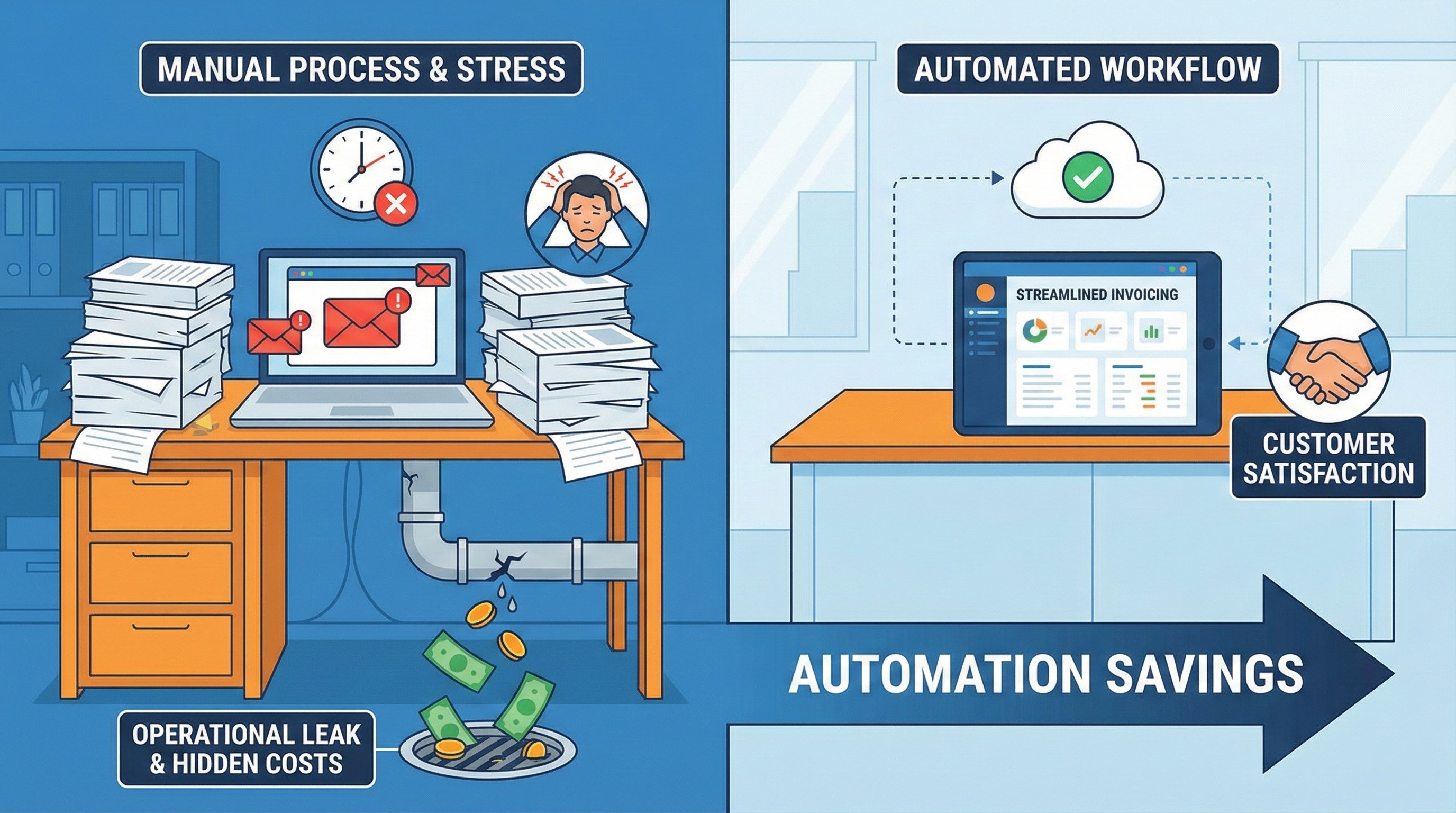
Most people think late payments only affect cash flow, but they impact operational efficiency just as much.
Common drain points include:
Dozens of emails and follow-ups every week
Misrouted invoices and missing POs
Time wasted re-sending the same documents
Incorrect invoice details creating unnecessary disputes
Duplicate data entry between systems
Stressful customer conversations that no one wants to make
Manual invoice processing is expensive. The cost difference between manual and automated workflows can easily exceed five figures per year for even a mid-sized service business.
AR inefficiency is not just a timing issue, it’s an operational leak.
Why Customers Really Pay Late (The Psychology)
Most customers don’t intend to pay late. It’s rarely personal.
Here are the psychological drivers behind delayed payments:
Friction leads to procrastination.
If your invoice is confusing, hard to access, or missing a payment link, it sinks to the bottom of the inbox.
You may not be a priority vendor.
Customers always pay the vendors who create the most consistent follow-up or the vendors who would cause the most pain if unpaid.
Unresolved issues delay payment.
If something about the work felt unclear or disappointing, customers hesitate to pay until they talk it out.
Cash-strapped customers avoid confrontation.
They don’t reply, even if they want to pay later.
Understanding these behaviors helps shape smarter AR processes and better follow-up communication.
Fixing the Foundations Before Introducing Automation
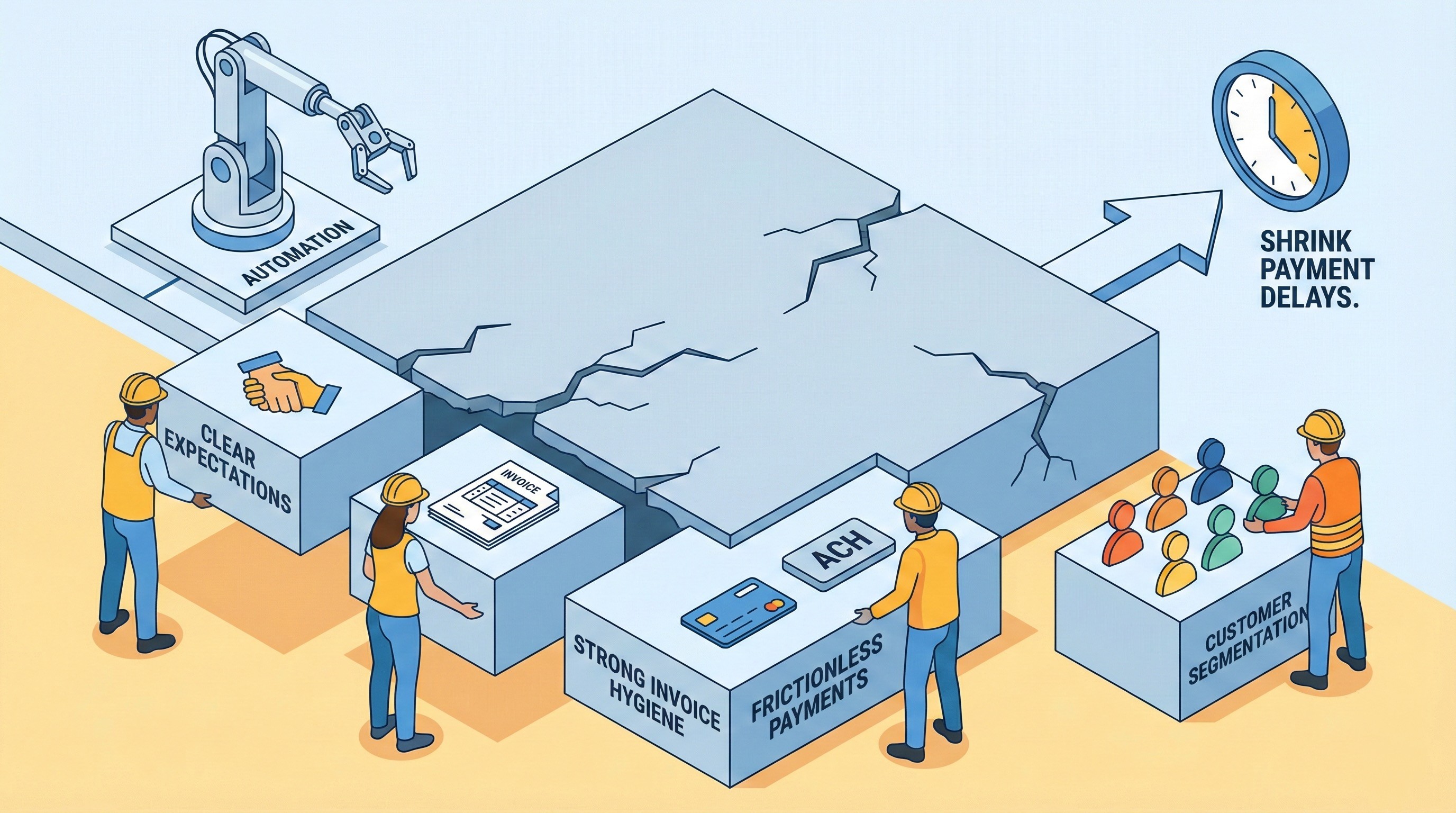
Even the best automation won’t save a broken workflow. Strong AR starts with clean, simple fundamentals:
Clear expectations at onboarding.
Make terms explicit. Verify the right billing contact. Communicate deposit requirements early.
Strong invoice hygiene.
Send invoices immediately. Include detail. Make them accurate. Include payment links. Reduce back-and-forth.
Frictionless payment options.
ACH, card, instant pay, fewer steps equals faster cash.
Customer segmentation.
High-value customers, high-risk accounts, or multi-contact organizations need different follow-up strategies.
These basics alone can shrink payment delays by weeks.
Where Automation Steps In and Transforms AR
The moment your invoice volume increases, manual collections break down:
Reminders become inconsistent
Finance teams avoid difficult conversations
Tasks slip through the cracks
Customers begin to “test” how long they can delay
Notes and records spread across multiple systems
Automation smooths out these failures:
Automated email/SMS reminders
Deliver predictable follow-up with friendly → firm escalation.
Automated cadences
Adjust tone based on overdue age.
AI voice agents (like Abivo)
Make friendly, consistent, natural-sounding phone calls to overdue customers, resolve objections, resend invoices, take promises to pay, and log everything automatically.
Predictive analytics
Surface which customers are likely to pay late, which invoices are at risk, and how payment behavior is shifting.
With automation, your AR becomes proactive rather than reactive.
Industry-Specific Realities and Playbooks

Different industries deal with different barriers, workflows, and customer behaviors. A few examples:
Trades: HVAC, plumbing, electrical
On-site payment and clean job-to-invoice syncing dramatically improve cash flow.
Medical and clinics
Insurance verification, payment plans, and text-to-pay reduce aging balances.
Professional services
Retainers, approval hierarchies, and auto-pay eliminate most overdue scenarios.
Customization here matters. A one-size-fits-all approach doesn’t work.
Building an AR Tech Stack That Actually Works Smoothly
Good AR depends on how well your tools talk to each other.
Common systems that should sync:
QuickBooks
Xero
NetSuite
Stripe / Square
Field service tools
CRM tools
Your AR automation platform (Abivo)
A connected stack ensures invoices go out fast, payments sync instantly, and no one manually updates spreadsheets anymore.
A Practical Roadmap to Improving Working Capital (No Numbering)
Here is the long-form, non-numbered roadmap, expanded:
Start with a full AR audit.
Look at overdue buckets, payment trends, customer segments, error sources, and disputed invoices. Understand your real bottlenecks.
Clean and correct all customer billing data.
Remove outdated contacts, verify email addresses, confirm approval workflows, fix missing POs, and standardize terms.
Improve your invoice process.
Send invoices immediately after service. Include clear descriptions. Eliminate errors that spark disputes.
Enable easier payment methods.
Add ACH, card, instant pay links, and customer portals.
Develop your communication scripts.
Friendly pre-due reminders, polite overdue nudges, assertive follow-ups, and dispute-resolution scripts.
Set up automation and AI tools.
Automated emails, consistent cadences, and AI voice follow-ups that work even when your team is slammed.
Fix recurring operational issues.
If the same client says “I never got the invoice,” the process is broken somewhere upstream. Patch those leaks.
Monitor progress weekly.
Track payment behavior, dispute frequency, and improvement in payment timelines.
Improve, refine, evolve.
AR is not a set-it-and-forget-it function. It needs tuning as you grow.
The Takeaway: AR Is a Growth Lever, Not a Back-Office Chore
When you tighten AR, you unlock cash you already earned, without borrowing money, raising prices, or increasing sales.
Better AR isn’t about “chasing people.”
It’s about building a smoother, faster, and more respectful payment experience for everyone.
With today’s automation and AI voice agents, even small teams can operate with enterprise-level efficiency.
Control AR → control cash flow → control growth.